

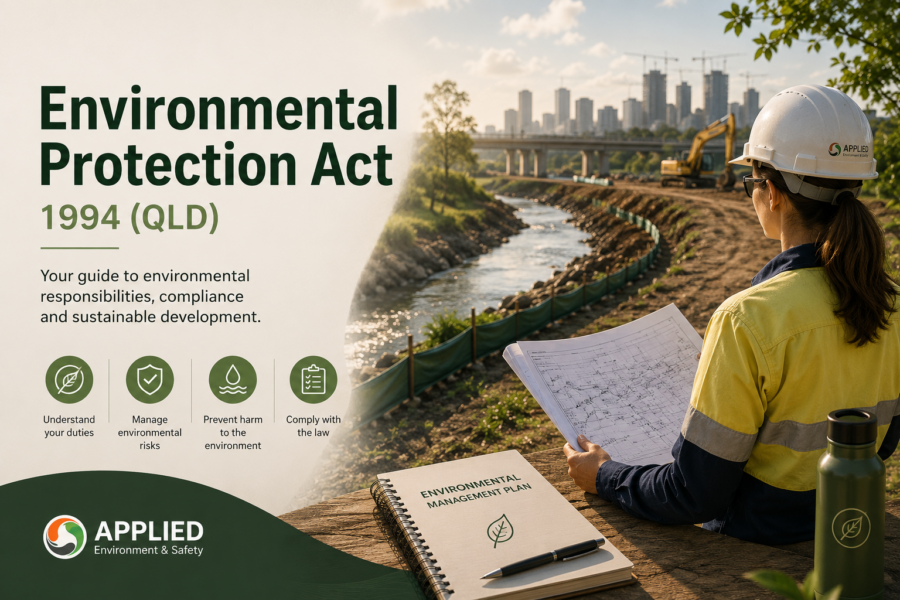
Environmental Protection Act QLD
Introduction to the Environmental Protection Act QLD
The Environmental Protection Act 1994 (QLD) is the cornerstone of environmental legislation in Queensland. It establishes the legal framework for protecting the state’s environment while supporting sustainable economic development.
For organisations working across construction, infrastructure, mining, energy, and civil works, the Act is particularly important because it applies broadly to activities that may cause environmental harm.
At the centre of the legislation is the concept of ecologically sustainable development, which aims to balance environmental protection with economic activity. The Act recognises that development is necessary, but it must occur in a way that protects environmental values for current and future generations.
Unlike some regulatory frameworks that apply only to licensed activities, the Environmental Protection Act has broad application. Many of its obligations apply even when a project does not require a specific environmental approval.
This means that developers, contractors, site supervisors, and project managers all have legal responsibilities under the Act. These responsibilities extend across project planning, construction, and operational phases.
For a broader overview of how this legislation fits within the state’s regulatory framework, see our guide to Environmental Legislation in Queensland.
What Is the Environmental Protection Act 1994?
The Environmental Protection Act 1994 establishes the legal mechanisms used by the Queensland Government to regulate environmental harm.
Its key objectives include:
- Protecting Queensland’s environmental values
- Promoting ecologically sustainable development
- Preventing, controlling, and reducing pollution
- Ensuring accountability for environmental harm
The legislation is administered primarily by the Queensland Department of Environment, Tourism, Science and Innovation (DETSI), which regulates compliance and enforcement.
Scope of the Act
The Environmental Protection Act applies to a wide range of industries and activities, including:
- Construction and infrastructure projects
- Mining and resource extraction
- Industrial facilities and processing plants
- Waste management operations
- Energy and renewable developments
The Act regulates activities that may cause environmental harm, whether through pollution, contamination, or environmental nuisance.
Regulated Environmental Harm
Environmental harm under the Act is generally categorised as:
- Material environmental harm – harm that is more than trivial but not severe
- Serious environmental harm – harm that is significant, widespread, or long-lasting
Examples may include:
- Sediment discharge into waterways
- Chemical spills affecting soil or groundwater
- Uncontrolled dust emissions impacting neighbouring properties
Importantly, environmental harm does not need to be intentional to trigger enforcement.
Enforcement Powers
The Act provides regulators with several enforcement tools, including:
- Environmental protection orders
- Stop-work notices
- Penalty infringement notices
- Prosecution for serious offences
These mechanisms allow regulators to respond quickly when environmental risks are identified.
What Is the General Environmental Duty (GED)?
One of the most significant provisions of the Environmental Protection Act is the General Environmental Duty (GED).
The GED requires that a person must not carry out an activity that causes or is likely to cause environmental harm unless all reasonably practicable measures are taken to prevent or minimise that harm.
This duty is deliberately broad and applies to almost all activities that could affect the environment.
Who the GED Applies To
The duty applies to anyone undertaking an activity, including:
- Project proponents
- Construction contractors
- Site supervisors
- Equipment operators
- Businesses and corporations
The responsibility is not limited to environmental specialists or compliance officers. It extends to individuals responsible for day-to-day project operations.
Environmental Harm Categories
The GED exists to prevent two primary categories of harm:
Material Environmental Harm
Environmental harm that:
- Is more than trivial or negligible
- Results in environmental damage
- Requires remediation
Serious Environmental Harm
Environmental harm that:
- Is irreversible or long-lasting
- Has a large-scale environmental impact
- Causes major contamination or ecosystem damage
Both categories carry significant regulatory consequences if prevention measures are not in place.
Applies Even Without Environmental Authority
A common misconception is that environmental obligations apply only when a project requires an Environmental Authority (EA).
In reality, the General Environmental Duty applies regardless of whether a project holds a licence or approval.
This means that even relatively small construction activities must consider environmental risks such as sediment runoff, dust, noise, and contamination.
2024 Amendments – The GED as a Standalone Offence
In 2024, the Queensland Government introduced significant changes to the Environmental Protection Act through the Environmental Protection (Powers and Penalties) and Other Legislation Amendment Act 2024.
These amendments strengthened enforcement powers and clarified regulatory expectations.
A key change was the introduction of the General Environmental Duty as a standalone offence.
Previously, regulators typically relied on environmental harm occurring before enforcement action was taken. The amendments now allow enforcement where organisations fail to take reasonably practicable steps to prevent harm.
Shift Toward Proactive Compliance
This change reflects a broader shift toward preventative environmental regulation.
Regulators are now increasingly focused on whether organisations can demonstrate that they have:
- Identified environmental risks
- Implemented appropriate mitigation measures
- Maintained monitoring and compliance systems
In practice, this means environmental management must be embedded into project planning and operations rather than treated as a reactive compliance task.
What Does “Reasonably Practicable” Mean?
A central concept within the General Environmental Duty is the requirement to take “all reasonably practicable measures” to prevent environmental harm.
While the term can appear ambiguous, regulators assess it based on several factors.
Likelihood of Harm
The more likely environmental harm is to occur, the greater the expectation that preventative controls will be implemented.
For example, projects operating in high rainfall regions must consider erosion and sediment risks as a predictable environmental hazard.
Degree of Harm
The severity of potential harm also influences what is considered reasonably practicable.
Activities that could contaminate waterways or sensitive habitats require stronger preventative measures than activities with lower environmental risk.
State of Knowledge
Regulators consider what is known about environmental risks within an industry.
If best-practice mitigation techniques are widely recognised, failing to implement them may constitute a breach of duty.
Availability of Controls
Where established environmental control measures exist, organisations are expected to adopt them.
Examples may include:
- Sediment basins and erosion controls
- Bunding for chemical storage
- Dust suppression systems
Cost Versus Risk
Cost may be considered, but it rarely outweighs the need to prevent significant environmental harm.
If relatively affordable measures can substantially reduce risk, regulators generally expect them to be implemented.
The Duty to Restore
Another important concept introduced through recent legislative updates is the Duty to Restore.
This obligation requires that a person responsible for environmental harm must take immediate action to restore the environment, where practicable.
Importantly, organisations cannot wait for a regulatory notice before responding.
Immediate Legal Obligation
If contamination, pollution, or environmental damage occurs, the responsible party must take steps to:
- Contain the impact
- Prevent further harm
- Begin remediation
Failure to act promptly may lead to enforcement action.
Practical Implications for Project Managers
For site managers and project supervisors, this means environmental incident response procedures must be clear and accessible.
Examples include:
- Spill response procedures
- Emergency containment measures
- Rapid escalation to environmental specialists
Well-prepared projects typically integrate these procedures into site environmental management systems.
Key Risk Areas Under the EP Act
While environmental risks vary by industry, several issues regularly arise on construction and infrastructure projects.
Erosion and Sediment Control
Disturbance of soil during construction can result in sediment entering waterways.
Effective management requires:
- Pre-disturbance planning
- Appropriate erosion controls
- Regular inspection and maintenance
Failure to manage sediment runoff is one of the most common compliance issues on construction sites.
Chemical and Waste Management
Improper handling of fuels, chemicals, or waste materials can lead to soil and groundwater contamination.
Key controls include:
- Bunded storage areas
- Spill response kits
- Staff training in hazardous material handling
Noise, Dust and Environmental Nuisance
Environmental nuisance can escalate into regulatory action when impacts affect surrounding communities.
Examples include:
- Persistent dust emissions
- Excessive construction noise
- Odour from waste or contaminated materials
Proactive monitoring and mitigation are critical to managing these risks.
Enforcement and Penalties
The Environmental Protection Act provides regulators with a range of enforcement options.
These include:
- Stop-work directions
- Environmental protection orders
- Penalty infringement notices
- Court prosecution
For serious breaches, penalties can include substantial fines and, in some cases, criminal liability.
Corporate officers may also face personal accountability if they are found to have failed in their environmental responsibilities.
Interaction with Other Laws
Environmental regulation in Queensland is rarely governed by a single piece of legislation.
The Environmental Protection Act interacts with several other regulatory frameworks, including:
- Planning Act 2016
- EPBC Act (Commonwealth)
- Fisheries Act 1994
- Environmental Authorities under resource legislation
For example, a project may require both development approval under the Planning Act and compliance with federal environmental obligations under the EPBC Act.
Understanding how these frameworks interact is essential for effective project planning.
How Applied Environment & Safety Supports Compliance
Applied Environment & Safety supports organisations across infrastructure, construction, mining, and energy sectors in navigating environmental obligations under the Environmental Protection Act, including managing the environmental approval process and liaison with the regulator.
Our services include:
GED Compliance Audits
Assessments that identify gaps in environmental risk management against General Environmental Duty requirements.
Construction Environmental Management Plans (CEMPs)
Preparation of structured environmental management frameworks tailored to construction and infrastructure projects.
Incident Response Support
Technical advice and response planning when environmental incidents occur.
Compliance Gap Analysis
Independent review of project environmental controls against regulatory expectations.
Duty to Restore Guidance
Practical support in responding to environmental incidents and meeting restoration obligations.
Early environmental planning and approvals work consistently reduces regulatory risk, project delay, and reputational exposure.
Why Environmental Compliance Must Be Proactive
The Environmental Protection Act establishes clear expectations for environmental responsibility in Queensland.
Key takeaways include:
- The General Environmental Duty applies broadly across industries
- Organisations must take reasonably practicable steps to prevent environmental harm
- Recent legislative amendments strengthen proactive enforcement
- Environmental incidents require immediate response and restoration
For organisations delivering infrastructure, energy, or resource projects, environmental compliance is not simply a regulatory requirement, it is a critical component of responsible project delivery.
Embedding environmental risk management into planning, construction, and operations provides greater certainty for project teams and reduces exposure to enforcement action.