When we talk about effective workplace health and safety management systems, we often talk about workplace hazards and risks. More specifically, how we can achieve proactive hazard identification followed by successful risk management.

So, what is hazard identification and risk management, how do we go about it, and why is it important in our workplace?

In this article, we answer these questions along with other common queries regarding hazard identification and risk management in the workplace.

What is a Hazard? What is a Risk?

A hazard is defined by Safe Work Australia as “a situation or thing that has the potential to harm a person“. A risk is defined as “the possibility that harm (death, injury or illness) might occur when exposed to a hazard“.

For example, boiling water in a saucepan on a kitchen cooktop is a hazard, as it has the potential to harm a person. The risk associated with this hazard is being burned, as this may occur if you are exposed to the hazard. Another common example of a hazard in the workplace is lifting heavy boxes (manual handling), the associated risks may include slips, trips or falls, or muscle sprains and strains while undertaking the manual handling (being exposed to the hazard). 

With an understanding of what hazards and risks are, we can now start to understand the hazard identification and risk management process.    

What is Risk Management?

The overall risk management process involves identifying hazards, assessing the risks associated with the hazard, implementing controls to eliminate or lower the risks then reviewing and maintaining the controls. We will now investigate each step of this process further.

Four Steps of Hazard Identification and Risk Management
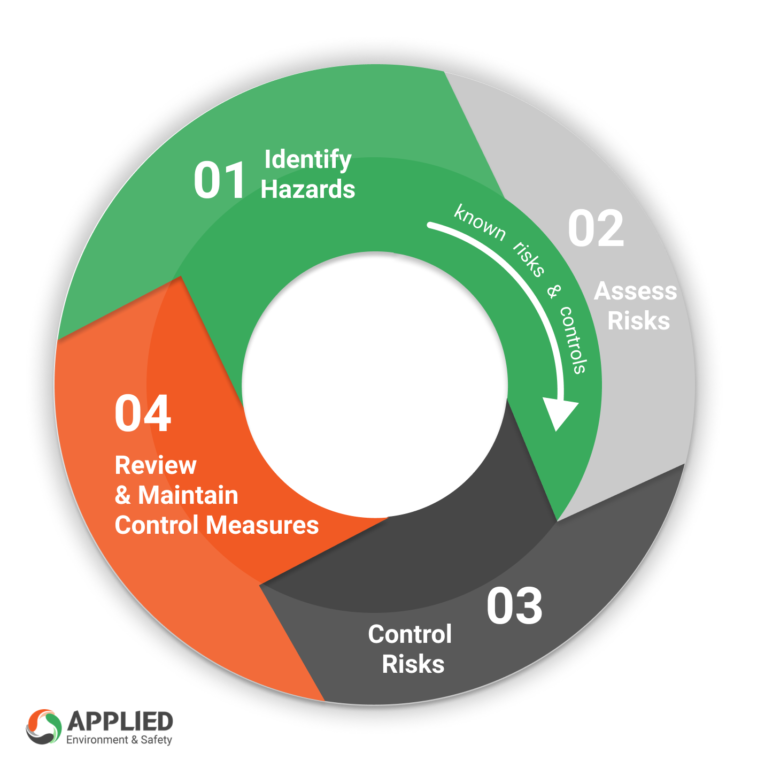
Four Steps of Hazard Identification and Risk Management Process
Steps of the hazard identification and risk management process

What is Hazard Identification?

Hazard identification in the workplace is the first important step in understanding your risks and implementing controls, where necessary. 

Hazard identification is best undertaken as a multi-faceted approach using a range of methods including the following:

1. Risk Assessment Workshops

Engage with management, staff, key stakeholders, etc. through collaborative workshops to discuss operations and tasks to identify hazards and assess risks.

2. Worker and Employee Consultation

Encourage staff feedback. Critically important for larger businesses where management cannot oversee all aspects of work. Front line workers are a great asset for identifying and reporting hazards.   

3. Workplace Inspections and Audits

Regular workplace inspections and audits help to reveal any new or changed workplace tasks or operations which may result in additional or changed hazards.

4. Incident Reporting and Review

Meticulous incident reporting and review highlights any key contributing hazards.  

5. Review of Operators Manuals and Safety Data Sheets (SDS)

Some hazards can be already identified on documents such as machinery, plant or vehicle operational manuals, or hazardous substances and dangerous goods SDS.

What are the types of Hazards?

Different hazards will be identified within your workplace depending on the nature and location of your operations. Hazards can be categorised into the following types:

Physical

Hazards that are physical conditions or factors within the workplace that can adversely impact health and safety. Examples include heat exposure, working at heights, working in confined spaces.

Biological

Hazards that may pose a biological threat to human health. Examples include diseases or viruses transmitted through human, animal, or plant matter.

Chemical

Hazardous chemicals which pose a human health risk if not correctly managed. Examples include flammable liquids, toxins or carcinogens.

Ergonomical

Hazards that are physical factors in the work environment that may cause musculoskeletal disorders or injuries. Examples include poor office and equipment layouts, workstation design.

Psychological

Hazards that are factors or aspects of work that have the potential to cause psychological harm. Examples include bullying, sexual harassment and fatigue.

What is the Aim of Hazard Identification?

Hazard identification is a crucial part in your overall risk management process. It provides a stocktake of all foreseeable and anticipated hazards that may arise in the workplace during typical operations as well as in an emergency situation. 

A thorough hazard identification process sets the foundations for targeted risk assessments, implementation of controls and overall management of risk for your operations.   

What is a Risk Assessment?

Assessing risks is the second step of the risk management process and is directly informed by the hazard identification stage. Risk assessment involves analysing each hazard to understand the related risks and the nature of harm that could be caused. A risk assessment should detail the severity of the risk (how serious are the consequences), as well as the likelihood of the risk resulting in injury or harm. Let’s look at our example of lifting heavy boxes again…

Heavy boxes (the hazard) are required to be moved from a removalist truck into a house. Staff moving the boxes will be exposed to the hazard while they are moving them, engaging in manual handling. During manual handling, there is a risk of muscle strains or sprains. 

There are various risk assessment matrices and tools to determine risk ratings, however for this example, let’s keep it simple. So we may determine the severity of the risk for a muscle strain as low-medium as it is typically not associated with a long-term disabling injury, however, it may require medical attention. The likelihood of this occurring during manual handling we might determine as high (probable). Based on our risk assessment we have now identified a highly probable risk with a low-medium severity rating.

Now we have identified and assessed our risk, let’s look at implementing controls.

How to Control Risks in the Workplace

Implementing controls can lower the severity or likelihood of the risk resulting in injury or harm. By lowering the severity and likelihood, the overall risk is reduced or may be eliminated. To determine effective and appropriate controls, the hierarchy of controls is used.

The hierarchy of controls outlines the most effective controls in reducing risk through to the least effective controls. Eliminating or removing the hazard is the highest level of control. If the hazard cannot be eliminated, the risk associated with the hazard can be lowered through isolation, substitution or engineering controls. Then, the risk of the hazard can be lowered using administrative controls. Lastly, personal protective equipment can be used to reduce the risk of harm to workers. Let’s look at our manual handling example again.

We cannot eliminate the hazard as moving heavy boxes is a key task for removalists. Engineering controls in the form of mechanical aid could be implemented such as use of pallet jack or trolley where possible. If engineering, isolation or substitution controls are not feasible, we could implement an administrative control, being a safe manual handling procedure and training for staff. A combination of controls may be required to lower the overall risk of the hazard.

Review and Maintain Control Measures

It is important to regularly review your controls to ensure their effectiveness. There are two main components to consider when reviewing your control measures. 

First, when you will review your controls. Managing hazards and risks is an ongoing process, so you should be reviewing your control measures regularly. A schedule should set for when the reviews will happen. How frequently these reviews are scheduled will depend on the nature of your organisation. For example, if your company deals with numerous high risks, your control measures should be reviewed more frequently.

In addition to a review schedule, your organisation’s work health and safety plan should include triggers that indicate when a risk review is required. By having these outlined, it will ensure that measures are reviewed in advance of your schedule if necessary. Risk control measures would be reviewed when:

  • The control measure is not working such as when someone is injured or experiences a ‘near miss’
  • Workplace layouts or practices are changed
  • New equipment, materials or work processes are introduced
  • A new problem is identified
  • Audits, inspections or consultation with identify that a review is necessary

Why is Risk Management Important for Your Organisation?

Now that we have an understanding of hazard identification and risk management, what are the benefits to your organisation?

All organisations have a legal responsibility in Australia to provide a safe work environment. Identifying hazards is the first step in removing or mitigating risks, and preventing work-related injuries or fatalities.

Additionally, being a responsible employer by taking an active role in worker safety by reducing hazards will reflect better on your company both in the market and community.

Need help with your hazard identification and risk management? Our team are skilled in a range of industries and operations, and would be happy to discuss how we can best help, contact us should you need support.
This article focuses on the key elements of environmental planning & environmental planning solutions that you need to consider when you are thinking about your upcoming project.

You have probably heard the saying, ‘If you fail to plan, then you plan to fail.’ This is true for any personal goal you are trying to reach, whether it be planning your exercise routine so you can finish your first marathon or planning your work schedule so you have enough time to take your annual fishing long weekend.

Planning is also important when it comes to upcoming development projects, expansions or new operations. Consideration of the environmental aspects in the earliest stages of planning sets you up for success by identifying risks and opportunities as well as timeframes and budgets.

This article focuses on the key elements of environmental planning that you need to consider when you are thinking about your upcoming project.

What Is Environmental Planning?

Firstly, lets clarify the scope and meaning of the ‘environment’. Under the Queensland Environmental Protection Act 1994 for example, the definition of environment is:

(a) ecosystems and their constituent parts, including people and communities; and

(b) all natural and physical resources; and

(c) the qualities and characteristics of locations, places and areas…; and

(d) the social, economic, aesthetic and cultural conditions that affect, or are affected by, things mentioned in paragraphs (a) to (c).

Under this definition, the environment is much more than the natural environment. The use of the term ‘social, economic, aesthetic and cultural conditions’ significantly broadens the meaning of environment and the scope of environmental planning.

Environmental planning is about:

  • Protecting natural ecosystems and biodiversity
  • Effectively utilising natural and physical resources
  • Protecting and enhancing air, land and water quality
  • Promoting sustainability and waste reduction
  • Minimising impacts on aesthetic and cultural heritage values of places
  • Ensuring that actions result in a net gain to local communities

The scope of environmental planning for projects may include approvals for development proposals that have environmental implications. It may also include environmental and social impact assessments. As well as approvals required to clear native vegetation, offset impacts, take natural resources or access protected land.

What Are Environmental Planning Solutions?

There are three key components of environmental planning: 

  1. First, is understanding the current status of the natural environment. This may include baseline environmental studies, evaluating existing land uses and identifying local community values.
  2. The second component is planned outcomes. This involves defining the scope and objectives of the development taking into consideration laws, regulations and best practice.
  3. The third component is implementation. This considers how the planning will be implemented during the project.

Environmental planning solutions consider the risks and opportunities of the development early within the planning process. Being proactive is more likely to lead to project success. This may include feasibility studies to determine the viability of the proposed development from an environmental and social perspective by identifying potential issues and threats to successful project completion. Involvement at the earliest stages of a project ensures securing timely environmental approvals as well as development of implementable controls and management outcomes.

Legislative Requirements

Environmental laws and regulations relevant to your development will be depend on the type of proposed operations and location. In Australia, federal, state and local governments jointly administer environmental protection laws. 

If your development is likely to affect areas of national environmental significance, you will need Commonwealth approvals prior to commencing your development. Use the Protected Matters Search Tool to check for areas of national environmental significance.

Your proposed development may also be regulated under State and Local government environment laws through licences and permits. In addition, government agencies and industry groups develop voluntary codes of practice to guide industry’s impact on the environment. These may also require integration into your development proposal.

Location and Project Description

Environmental planning needs to consider the development location and associated values. This may include undertaking baseline studies, such as water quality or flora and fauna, of the area and surrounds. As well as consideration of historical and planned land uses, local community interests, and cultural heritage values. This provides context to the development and will identify potential constraints and opportunities for the project.

Understanding Stakeholders 

Under environmental legislation in Australia, there is a requirement for public notification of some developments. Public notification ensures that interested stakeholders are aware of the development and they have the opportunity to make submissions. There are requirements in regards to public notices, submission periods and response to submissions under different legislation. 

Early engagement with stakeholders provides the opportunity to introduce the project and commence the development of relationships. Early relationships provide the opportunity to test ideas, at phases where decisions are able to be influenced by key stakeholders, which will lead to positive outcomes for all parties. 

Why are Environmental Planning Solutions important?

Most projects clearly define their objectives, work scope, budget, and schedule but, all too often, the environment and context in which the project exists is neither fully understood nor clearly defined. This is a major source of risk when it comes to project management and execution.

Environmental planning should start at the beginning of a project, expansion or new operation. Commencing in the earliest stages of project planning, such as feasibility studies or early contractor involvement, sets up the project for success by identifying risks and opportunities. This leads to the delivery of the project on time and within budget. If the project management team do not fully understand the environmental context, the project will, in all likelihood, fail. This is because the environmental context drives project performance as much as a clearly defined work scope, budget, or schedule.

Environmental Approvals and Permits

Scoping the types of environmental approvals and permits required, and commencing communications with the key regulators, should be implemented early in the environmental planning process. This assists in securing environmental approvals within the timeline of the project. As well as providing an early understanding of likely conditions to be applied to the development.

Stakeholder Expectations

Early planning provides the opportunity to introduce the project to regulators, community and other stakeholders. This provides the opportunity to develop a good, open reputation and positive relationship with key stakeholders. This will potentially lead to less conflicts and shorter assessment times through early participation in the environmental assessment process.

Early Contractor Involvement (ECI) & Tenders

Implementation of environmental planning during the Early Contractor Involvement (ECI) or Tender phase of the project allows risks and opportunities to be identified. Involvement during ECI contracts allows consideration of designs to mitigate and minimise environmental impacts. Also for large or complex projects, this allows an integrated team time to gain an early understanding of requirements, enabling robust risk management and innovation. Environmental planning during tenders allows identification of risks likely to affect work scope, budget, and schedule. This is essential to being able to plan, implement, and control a project effectively.

Environmental Management Plans

As part of environmental planning, an Environmental Management Plan (EMP) is developed to detail management measures to be implemented during the project. The EMP identifies environmental issues and provides strategies for managing them effectively. The EMP should cover the design, construction, commissioning, and operation and maintenance phases of each project component.

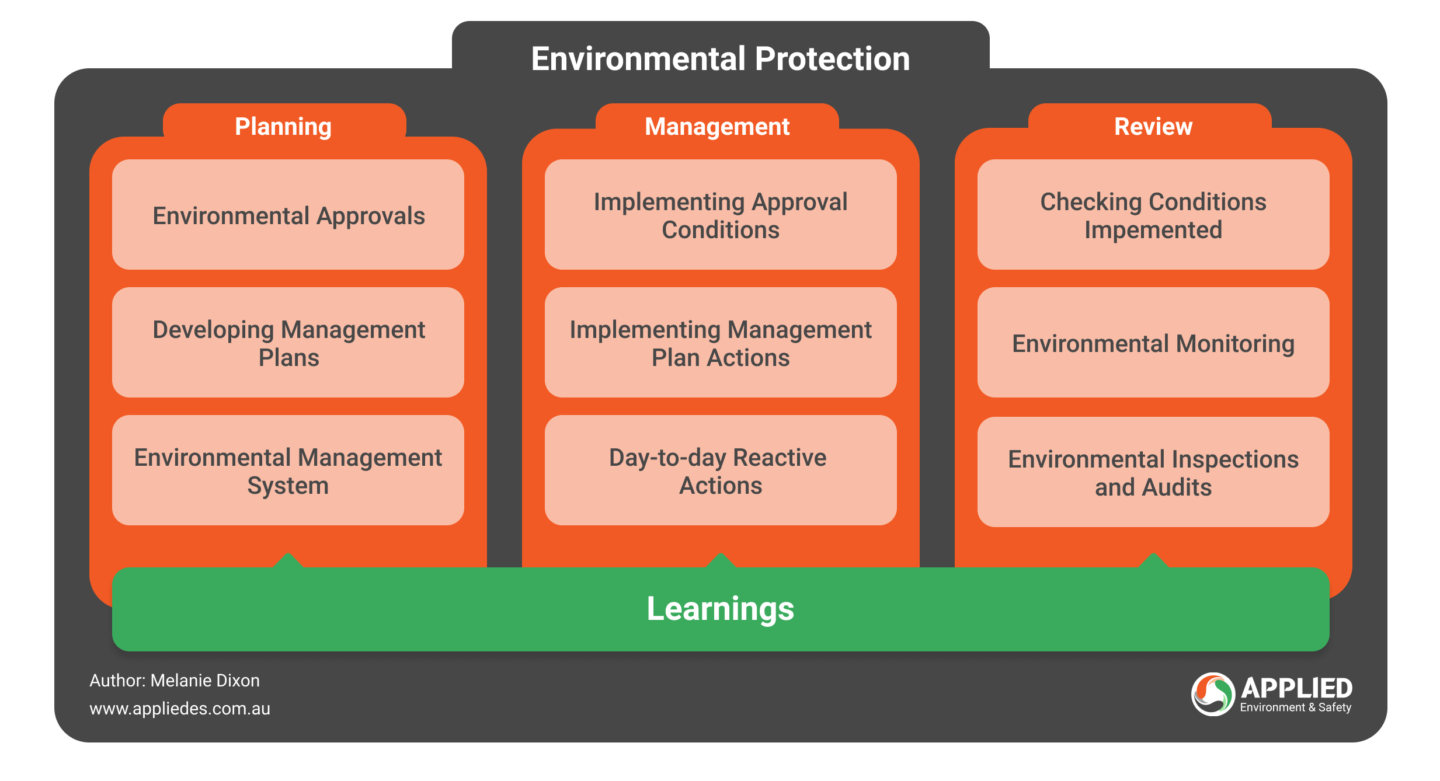
This diagram hereunder helps visualise how environmental planning and environmental management fits and contributes to environmental protection as a whole.

Environmental Protection: Environmental Planning and Environmental Management

Diagram
Environmental Protection: Planning & Management

Should your project need help with environmental planning solutions and management, Applied Environment & Safety have a wide experience working with a range of business sectors. View our project portfolio for more information or contact us if you would like to speak directly.