This article focuses on the key elements of environmental audits & inspections and the benefits these processes have on your operations.
For management plans and systems to be effective, they must be integrated into your operations. The purpose of environmental audits and inspections is to assess your management systems to determine if they are effectively managing risks to the environment, as well as identify opportunities for improvement. Evaluation of the implementation of your management processes leads to reduced risks and continuous improvement.
Environmental audit meaning defined
An environmental audit is a systematic, independent and documented process for determining whether management systems and processes effectively address specific risks and are being implemented in accordance with internal and external requirements.
The objective of an environmental audit is to assess operations to identify strengths and weaknesses, determine effectiveness and compliance, and measure progress. This may be in relation to:
Compliance with relevant statutory and best practice requirements
Implementation of policies, standards and procedures
Management control of environmental practices
Staff awareness of risks and controls
Maintaining accreditation or other external stakeholder requirements
Exploring improvement opportunities
An environmental audit should provide a fair and true reflection of the management system by obtaining audit evidence and evaluating it objectively against audit criteria.
How are environmental audits important to your operations?
Environmental auditing has a critical role to play in ensuring that organisations fulfil their commitments to environmental management and performance. Audits can provide key information to management on areas of risk, and progress towards strategic objectives and targets.
Audits enable management to understand exactly what is happening within the organisation and to check the operation (or otherwise) of plans, systems and procedures. Undertaking regular environmental audits is a proactive measure to ensure compliance with regulatory requirements and stakeholder expectations. Indeed, evidence suggests that environmental audits have a valuable role to play, encouraging systematic incorporation of environmental perspectives into many aspects of overall operations, helping to trigger new awareness and priorities in policies and practices.
Environmental auditing can help reveal the likely weaknesses of an organisation’s processes, therefore reducing the risk of unexpected events. A properly prepared and conducted environmental audit has great benefits and adds value to an organisation that is committed to act on the results.
Environmental Compliance
Environmental compliance means conforming with relevant environmental laws, regulations, standards and other requirements. The importance of being environmentally compliant isn’t just about being green, it is essential to ensuring the success of your operations by limiting your exposure to penalties and public scrutiny as well as identifying opportunities for improvement.
An environmental audit can be used to investigate the compliance status your operations and/or the extent of your environmental liability. This process is a systematic evaluation focusing on current operations and management procedures and processes. Assurance through auditing verification and reporting programs can be used to identify gaps and limitations as well as allocate ownership and accountability to the process of implementing environmental compliance for your operations.
Environmental Audits vs Inspections
An environmental audit evaluates the compliance of management systems and practices within an organisation with regulations, internal policies or other compliance drivers. While an environmental inspection looks for risks and implementation of controls for a specific operation.
Given that the goal of an environmental audit is to assess overall compliance of processes, they are typically performed less frequently than inspections. Audits are typically conducted by a third-party to the site being audited. This could be an auditor from another company site or an auditor completely external to the company.
Inspections are typically the reoccurring completion of checklists by operational personnel, such as Site Managers or Environmental Advisors. Inspections can be thought of as compliance tasks with checklists. For example, an inspection can be used to determine if specific controls are being implemented effectively.
Types of Environmental Audits
In general, there are three types of environmental audits:
System audits: these audits check that your system is compliant with standards or guidelines that your system has been developed in accordance with such as ISO 14001: Environmental Management Systems. These audits check that all policies, procedures and other required documented information is available and up to date.
Operational audits: these audits check if you are doing what you say you are doing. Your system audits should confirm that the correct procedures have been developed, however these operational audits confirm you are actually implementing them.
Compliance audits: Sometimes called legal audits. These audits should check that you are complying with all the legislation and other requirements that are applicable to your operations. They should cover all of your activities, products and services and all your legal requirements.
Use for Environmental Inspections
An inspection looks for compliance with controls as well as any new or changed risks and poor practices. An environmental inspection could be used to:
Observe work practices to identify the effectiveness of controls
Examine whether construction or operations present any environmental risks
Check whether controls and other management practices are effective
5 Step Environmental Audit Process
5 Step Environmental Audit Process
The main steps of an environmental audit are detailed below.
Step 1: Plan the Audit
The first step in the environmental audit is to establish and document the scope and terms of reference. The scope could include one or more sites or specific operations to be audited. While the terms of reference is the reason for the audit such as ISO 14001 certification or compliance with specific legislation requirements.
Step 2: Prepare for the Audit
An environmental audit guidance tool must be prepared for each audit activity. The audit guidance tool may be in the format of a checklist, list of interview questions, marked-up procedures, flow charts or mind maps.
An audit plan should also be developed. The audit plan is used to schedule activities and meetings with auditees within each audit, including the opening meeting and interviews.
Step 3: Conduct the Audit
Prior to conducting the audit, all relevant personnel in the audit team should meet to discuss the scope of the audit, proposed audit agenda, audit objectives, any personnel that need to be contacted or interviewed, and a tentative time to hold the closing meeting.
Step 4: Develop an Audit Report or Action Plan
The environmental audit team needs to prepare a report based on all the objective evidence that is collected during the audit. The audit report should be completed based on agreed content in the closing meeting.
Step 5: Audit Follow-Up
Following the completion of the audit, actions to close out any non-conformances or suggested improvements should be implemented and tracked. This can be done separately or as part of the audit report.
Our 5 Tips for Preparing for an Environmental Audit
There are many benefits of undertaking and participating in environmental audits. This includes identifying and preventing risks, determining which processes are working well, and looking for opportunities for improvement.
These are our five tips for getting the most out of your environmental audit:
1. Understand what is being audited. It is your licence or approval requirements? Or a particular aspect of your environmental management system or operations? Or recertification of your management system? If you are unclear, then clarify with the auditor so that you can be prepared for the audit.
2. Know the audit schedule. Otherwise, ask the auditor for the schedule so again you can be prepared.
3. Make sure worksites are clean and tidy. As an auditor walking into a tidy and well-maintained work area, you are instantly impressed and this starts the audit off on the right foot.
4. Be cooperative. An environmental auditor is there to help you. They are a fresh pair of eyes to notice something that you have overlooked and provide suggestions to improve management processes. Use this to your advantage by assisting to determine suitable solutions to improve your operations.
5. Closeout any non-conformances or improvements as soon as possible. This will provide the greatest benefit to your operations as well as preventing lingering items on your To-Do list.
How Can We Help?
If your project is in need of an environmental audit & inspection, our team are here to help. With vast experience in a wide range of industries, we are equipped to support your project needs. Contact us with your request.
An Introduction To Environmental Planning Solutions
This article focuses on the key elements of environmental planning & environmental planning solutions that you need to consider when you are thinking about your upcoming project.
You have probably heard the saying, ‘If you fail to plan, then you plan to fail.’ This is true for any personal goal you are trying to reach, whether it be planning your exercise routine so you can finish your first marathon or planning your work schedule so you have enough time to take your annual fishing long weekend.
Planning is also important when it comes to upcoming development projects, expansions or new operations. Consideration of the environmental aspects in the earliest stages of planning sets you up for success by identifying risks and opportunities as well as timeframes and budgets.
This article focuses on the key elements of environmental planning that you need to consider when you are thinking about your upcoming project.
What Is Environmental Planning?
Firstly, lets clarify the scope and meaning of the ‘environment’. Under the Queensland Environmental Protection Act 1994 for example, the definition of environment is:
(a) ecosystems and their constituent parts, including people and communities; and
(b) all natural and physical resources; and
(c) the qualities and characteristics of locations, places and areas…; and
(d) the social, economic, aesthetic and cultural conditions that affect, or are affected by, things mentioned in paragraphs (a) to (c).
Under this definition, the environment is much more than the natural environment. The use of the term ‘social, economic, aesthetic and cultural conditions’ significantly broadens the meaning of environment and the scope of environmental planning.
Environmental planning is about:
Protecting natural ecosystems and biodiversity
Effectively utilising natural and physical resources
Protecting and enhancing air, land and water quality
Promoting sustainability and waste reduction
Minimising impacts on aesthetic and cultural heritage values of places
Ensuring that actions result in a net gain to local communities
The scope of environmental planning for projects may include approvals for development proposals that have environmental implications. It may also include environmental and social impact assessments. As well as approvals required to clear native vegetation, offset impacts, take natural resources or access protected land.
What Are Environmental Planning Solutions?
There are three key components of environmental planning:
First, is understanding the current status of the natural environment. This may include baseline environmental studies, evaluating existing land uses and identifying local community values.
The second component is planned outcomes. This involves defining the scope and objectives of the development taking into consideration laws, regulations and best practice.
The third component is implementation. This considers how the planning will be implemented during the project.
Environmental planning solutions consider the risks and opportunities of the development early within the planning process. Being proactive is more likely to lead to project success. This may include feasibility studies to determine the viability of the proposed development from an environmental and social perspective by identifying potential issues and threats to successful project completion. Involvement at the earliest stages of a project ensures securing timely environmental approvals as well as development of implementable controls and management outcomes.
Legislative Requirements
Environmental laws and regulations relevant to your development will be depend on the type of proposed operations and location. In Australia, federal, state and local governments jointly administer environmental protection laws.
If your development is likely to affect areas of national environmental significance, you will need Commonwealth approvals prior to commencing your development. Use the Protected Matters Search Tool to check for areas of national environmental significance.
Your proposed development may also be regulated under State and Local government environment laws through licences and permits. In addition, government agencies and industry groups develop voluntary codes of practice to guide industry’s impact on the environment. These may also require integration into your development proposal.
Location and Project Description
Environmental planning needs to consider the development location and associated values. This may include undertaking baseline studies, such as water quality or flora and fauna, of the area and surrounds. As well as consideration of historical and planned land uses, local community interests, and cultural heritage values. This provides context to the development and will identify potential constraints and opportunities for the project.
Understanding Stakeholders
Under environmental legislation in Australia, there is a requirement for public notification of some developments. Public notification ensures that interested stakeholders are aware of the development and they have the opportunity to make submissions. There are requirements in regards to public notices, submission periods and response to submissions under different legislation.
Early engagement with stakeholders provides the opportunity to introduce the project and commence the development of relationships. Early relationships provide the opportunity to test ideas, at phases where decisions are able to be influenced by key stakeholders, which will lead to positive outcomes for all parties.
Why are Environmental Planning Solutions important?
Most projects clearly define their objectives, work scope, budget, and schedule but, all too often, the environment and context in which the project exists is neither fully understood nor clearly defined. This is a major source of risk when it comes to project management and execution.
Environmental planning should start at the beginning of a project, expansion or new operation. Commencing in the earliest stages of project planning, such as feasibility studies or early contractor involvement, sets up the project for success by identifying risks and opportunities. This leads to the delivery of the project on time and within budget. If the project management team do not fully understand the environmental context, the project will, in all likelihood, fail. This is because the environmental context drives project performance as much as a clearly defined work scope, budget, or schedule.
Environmental Approvals and Permits
Scoping the types of environmental approvals and permits required, and commencing communications with the key regulators, should be implemented early in the environmental planning process. This assists in securing environmental approvals within the timeline of the project. As well as providing an early understanding of likely conditions to be applied to the development.
Stakeholder Expectations
Early planning provides the opportunity to introduce the project to regulators, community and other stakeholders. This provides the opportunity to develop a good, open reputation and positive relationship with key stakeholders. This will potentially lead to less conflicts and shorter assessment times through early participation in the environmental assessment process.
Early Contractor Involvement (ECI) & Tenders
Implementation of environmental planning during the Early Contractor Involvement (ECI) or Tender phase of the project allows risks and opportunities to be identified. Involvement during ECI contracts allows consideration of designs to mitigate and minimise environmental impacts. Also for large or complex projects, this allows an integrated team time to gain an early understanding of requirements, enabling robust risk management and innovation. Environmental planning during tenders allows identification of risks likely to affect work scope, budget, and schedule. This is essential to being able to plan, implement, and control a project effectively.
Environmental Management Plans
As part of environmental planning, an Environmental Management Plan (EMP) is developed to detail management measures to be implemented during the project. The EMP identifies environmental issues and provides strategies for managing them effectively. The EMP should cover the design, construction, commissioning, and operation and maintenance phases of each project component.
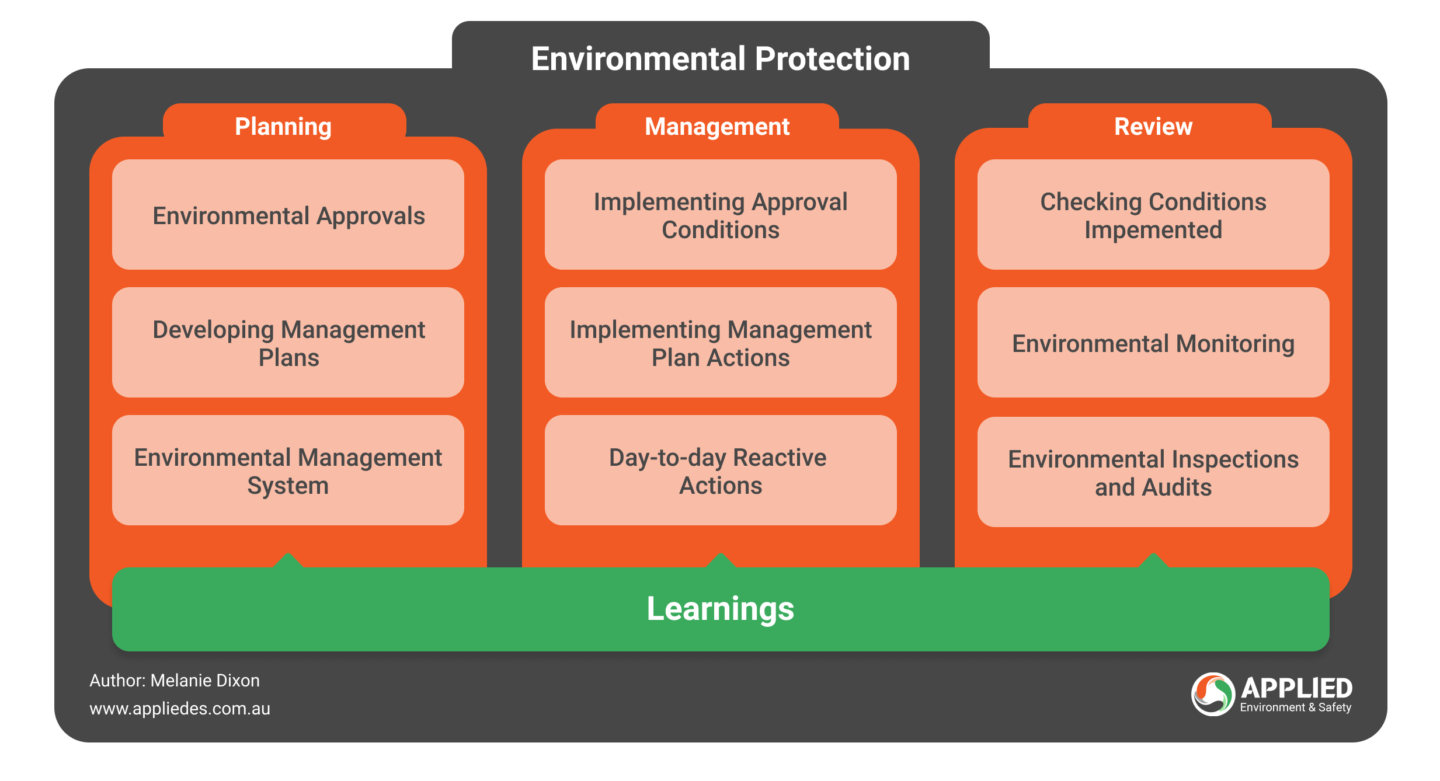
This diagram hereunder helps visualise how environmental planning and environmental management fits and contributes to environmental protection as a whole.
Environmental Protection: Planning & Management
Should your project need help with environmental planning solutions and management, Applied Environment & Safety have a wide experience working with a range of business sectors. View our project portfolio for more information or contact us if you would like to speak directly.
Applied Environment & Safety has been providing ongoing health and safety support to a local furniture removal and transport company for several years. This support has included quarterly inspections of warehouse operations and assistance with external audits.
We have provided support to our client during external audits. This has included Australian Furniture Removals Association (AFRA) membership compliance audit as well as a Queensland Fire & Emergency Services (QFES) compliance inspection. We assisted our client with working through solutions for audit non-compliances, updating management plans and liaising with external bodies.
We believe in the value of our industry and are passionate about achieving action based outcomes for our clients. During quarterly inspections, we work closely with Chess Moving, Brisbane to develop actions to improve their safety performance and recommend implementable solutions. This has included establishing designated work zones; implementing chain of responsibility requirements; hazardous goods storage and use; and improving housekeeping measures.
We have developed simple ways to assist our client with implementation of their Safety Management System. To assist with implementation we developed forms, checklists and registers for daily use by operational staff. We supported and trained management staff in implementing processes such as staff and contractor onboarding, routine workplace inspections and incident reporting.
When Chess Moving relocated to a new warehouse, we were engaged to develop and deliver a warehouse induction and safety refresher training package for all staff and contractors. We also set-up work zones, traffic management requirements and emergency evacuation procedure for the new warehouse.
We continue to have a close working relationship with Chess Moving, Brisbane. We enjoy working together to improve their safety processes.
For further information on how we could provide practical health and safety support to your business, contact us.
Environmental Inspection & Audit for $8.1M Road Project
Applied Environment & Safety recently provided environmental inspection and auditing support to Hazell Bros during their Bruce Highway intersection upgrades and safety widening project located between Gympie and Maryborough in south east Queensland.
This $8.1 million road project involved road widening works, flattening roadside slopes and installing guard rails as well as providing safe turning lanes. This project forms part of the Bruce Highway Upgrade Program aimed at improving road safety for the local community.
Our role on this local project included providing environmental support and inspection during construction. We believe in using our expertise and knowledge to add value and improve project outcomes for our clients. We used our extensive construction knowledge to identify environmental risks and provide practical solutions.
We assisted this project by conducting environmental audits focussed on the obligations in the Construction Environmental Management Plan. We also completed regular inspections of the works to identify environmental risks for each stage of construction.
Bruce Highway Environmental Inspection & Audit
Observations and recommendations were delivered in timely reports. The reports had details of observations from the environmental inspections and compliance against the environmental requirements to ensure the effective implementation of the Construction Environmental Management Plan.
Bruce Highway Sediment & Erosion Control
Environmental aspects observed and monitored for this project include:
– Erosion and sediment contro
– Surface water and stormwater runoff
– Noise and vibration management
– Hydrocarbon management and spill prevention
– Dust management
– Biosecurity management
– Waste Management
Environmental controls were effectively implemented by Hazell Bros during this project. We believe in working closely with our clients to build supportive relationships. By working together, we were able to ensure environmental risks were mitigated for this project.
For more information on other projects we have supported, visit our Projects page.
Department of Defence Training Area Remediation Project
Applied Environment & Safety has continued to provide Environmental Advisor support for the Department of Defence Shoalwater Bay Training Area remediation project. This $125 million project managed by Downer and FKG as a joint venture involves upgrades to key infrastructure and facilities within the training area to allow for sustainable ongoing military use while maintaining the environmental values of the area.
This Training Area covers over 454,000 hectares of diverse landscapes and marine environments in central Queensland. It is located within protected areas including the Great Barrier Reef Marine Park World Heritage Area and Shoalwater and Corio Bays Ramsar Wetlands. As well as various areas of protected flora and fauna habitat.
Key construction upgrades include rebuild of the Urban Operations Training Facility consisting of a mock city with full-scale buildings and structures. As well as airfield upgrades with an additional aeromedical evacuation landing zone; construction of a new field hospital; road upgrades and new beach landings; and extensive creek crossing upgrades throughout the training area.
Given the significant environmental sensitivities of the project area, compliance with regulatory and client requirements and implementation of environmental best practice is the highest priority.
Our responsibilities on this remediation project included obtaining pre-work environmental clearance certificates, mapping extents of vegetation clearing, providing advice for site rehabilitation, and monitoring ongoing environmental compliance against project requirements. We worked closely with key stakeholders including Department of Defence Environmental Officers, civil and landscaping contractors, and specialist consultants to facilitate project delivery.
A primary deliverable for Applied Environment & Safety was to map the extent of vegetation clearing required for creek crossing upgrades throughout the Training Area. This involved working with civil contractors and project engineers at each site to capture the disturbance footprint. This mapping was compiled and provided to the Department of Defence for approval of the works.
Now during completion of the project, we are assisting with the closure of the environmental clearance certificates and providing advice on rehabilitation requirements. This includes permanent sediment and erosion controls and hydro-mulching.
Our secondment into this complex multifaceted project presented the challenge of acquiring an understanding of the project’s issues, stakeholders involved and environmental requirements within a short timeframe. However, by taking a proactive approach to engage with stakeholders to understand project expectations and application of our technical knowledge and construction experience, the project has been successfully supported to the satisfaction of all stakeholders.
For more information on our services, visit our Services Page.
Applied Environment & Safety have recently extended our ‘lead by example’ approach by implementing the first steps towards becoming a carbon neutral business.
To formalise this carbon neutral goal, Applied Environment & Safety have registered with Climate Active Australia. Climate Active certifies businesses and organisations committed to measuring, reducing and offsetting their carbon emissions.
Currently, we are analysing our emission data to establish a carbon inventory and calculate our total net CO2 output for 2020. This carbon inventory and total net emissions data will be used to set a baseline year to monitor ongoing emissions. This will also be used to identify opportunities for reducing emissions and secure carbon offsets to achieve net zero emissions.
Once our carbon inventory and total net emissions have been calculated, the data will be independently reviewed and verified by a registered consultant. Following this review, we will seek opportunities to reduce our carbon emissions and offset any remaining emissions. We will then have made the change to carbon neutral.
This process will be certified through the Climate Active program. Climate Active certification is awarded to Australian businesses that have met rigorous requirements to achieve net zero carbon emissions. This requires a business to credibly reduce their greenhouse gas emissions and then offset any remaining emissions through the purchase of carbon offsets.
For more information on Climate Active Australia and their initiatives visit: Climate Active Australia
While we are a small business with relatively low carbon emissions, we believe in being responsible for our role in protecting the climate and implementing sustainable business practices.
Stay tuned for updates on our progress towards becoming a certified carbon neutral business.
Environmental and Landholder Support from Planning to Rehabilitation
Applied Environment & Safety provided environmental and landowner liaison support from planning through to rehabilitation for the TransGrid Wagga Wagga to Tumut transmission line rebuild project. This 18-month, $20 million project involved the replacement of 243 wooden pole structures spanning 80 km across diverse landscapes in central New South Wales.
Our support to the project commenced during planning with the development of the Construction Environmental Management Plan and other approvals. Then onsite environmental management and compliance support throughout construction.
Rehabilitation Starts with Planning
Due to project area being located partially within the Snowy Mountains, substantial earthworks were required to establish safe access and construction work areas. These large-scale disturbed areas were monitored and managed throughout the project.
We worked closely with contractors and landowners throughout the project from initial access and vegetation clearing works through to final site rehabilitation. Early engagement with earthmoving contractors ensured valuable topsoils and vegetation were managed appropriately for reuse in rehabilitation. Other rehabilitation controls included erosion and sediment controls; topsoil stockpiling and management; and seeding to promote vegetation growth and ground stabilisation.
By working closely with landowners throughout the project, this ensured expectations of final site conditions were agreed upon and rehabilitation works carried out accordingly.
This project was completed in mid-2020 following extensive rehabilitation works. Now, several months after the project’s completion, disturbed areas are progressively returning to their pre-work condition.
All works were completed on schedule and to the satisfaction of all stakeholders.
For information on other transmission line projects that we have supported, visit our Projects page.
ElectraNet Eyre Peninsular Transmission Line Project
Applied Environment & Safety have been providing environmental support in the early contractor involvement (ECI) stage of the ElectraNet Eyre Peninsular transmission line upgrade project. This $290 million project involves constructing a new 270 km double-circuit 132 kV transmission line from Cultana to Port Lincoln in South Australia as well as major construction works on substations.
Environmental support for this ECI phase involves input into design, site investigations and development of management plans for construction. Our knowledge of transmission line construction phases and the potential associated environmental risks allows us to develop effective controls for our client.
A main component of this phase is the development of issue specific environmental management sub-plans. This has included soil, water, vegetation, waste, landholder and cultural heritage. A focus has been weed mitigation and management. Baseline weed surveys have been contracted. Weed management zones and control measures will be determined for construction.
We believe in providing practical environmental management services. This means when developing sub-plans, we apply our practical construction knowledge to ensure implementable solutions along with environmental best practice.
Also permit applications and supporting documents have been developed. This has included a Water Affecting Activities Permit for the construction of waterway crossings. For this permit, spatial data has been ground-truthed. Then crossings designed to minimise impact on the waterway channel and mitigate erosion and sedimentation.
We have been working closely alongside our project partners to be adaptive and flexible in our outputs and delivery. This is a very interesting major project that we are enjoying providing technical environmental support.
For other projects we have supported, visit our Projects page
Applied Environment & Safety are implementing sustainability into our business through the CCIQ ecoBiz program. We have been awarded three star ecoBiz partnership through our energy, water and waste initiatives.
CCIQ ecoBiz is a free program, funded by the Queensland Government, that helps businesses save money through reducing energy, water and waste. ecoBiz has been very successful, and worked with thousands of Queensland businesses.
Applied Environment and Safety has been an active participant in the ecoBiz program and a recognised Star Partner for several years. Given that our business operates either from our home office or client locations, the ecoBiz assessment this year was completed on merits of best practice rather than a quantitative analysis of business resource intensity.
The assessment was based on initiatives and behaviours which demonstrate implementation of business sustainability practices, and minimisation of environmental footprint. Our sustainable business initiatives for 2020-21 for energy, water and waste are listed below.
Energy
Aim: Progression towards carbon neutrality
Carbon offsets to be purchased for employee flights taken through the 2019-20 financial year
Track and record vehicle travel
Switch to carbon neutral electricity including explore costs for installation of solar panels on home office
Water
Aim: Protecting local waterways
Opportunities to donate (time or money) to a local catchment group
Ongoing rehabilitation of council verge bushland at home office including removal of weeds, replanting native plants and mulching as waterwise garden
Waste:
Aim: Shift towards zero-waste
Implement office clean-up including recycling or donation of disused electronic equipment
Ongoing implementation of Containers for Change Refund Scheme including when working with our clients
Opportunities to contribute to upcycling and recycling programs such as The Breadtag Project. This is a campaign raising awareness for the ubiquity and overconsumption of single-use plastics
We will keep you updated on the progress of these initiatives. Tracking of our carbon offsets, container recycling and donations are reported on our website. Visit our about us page to find out more about the team.
Applied Environment & Safety provided onsite environmental support for the rebuild of the TransGrid Wagga Wagga to Tumut transmission line. This was a substantial project involving the replacement of 243 structures over an 18-month period.
The transmission line traversed diverse landscapes from low lying cropping paddocks to steep rocky terrain within the Snowy Mountains region. The project’s most significant environmental challenge was sediment and erosion control for the large scale construction of access tracks and structure pads.
Sediment and erosion control measures included:
Preparation of sediment and erosion control plans.
Full engagement with the civil contractors on construction requirements for tracks and pads.
Ongoing maintenance of controls over the life of the project.
Rehabilitation of disturbed areas following completion of works.
Prior to breaking ground, Applied Environment and Safety worked closely with the civil contractors to ensure best practice controls were incorporated into construction. Ensuring the access tracks and pads were constructed correctly decreased the maintenance required over the project lifespan.
Some sites proved especially challenging with highly erodible soils, steep terrain and livestock. Livestock enjoy investigating and quickly destroying a well-designed catch drain.
Routine inspections throughout the project ensured erosion and sediment deposition was avoided, and controls were maintained.
Following completion of the works, disturbed areas were rehabilitated in accordance with the requirements of landowners and best practice. Applied Environment and Safety worked closely with landowners throughout the project to ensure a mutual understanding of how disturbed areas would be remediated.
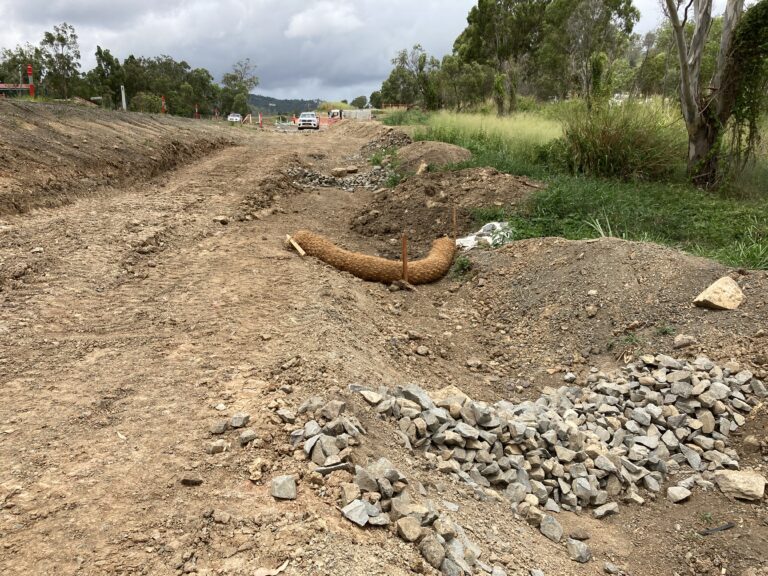
Generally, rehabilitation works involved levelling the subsoil back to natural ground level and spreading stockpiled topsoil over the site with a pasture seed mix. Alternatively, disturbed areas that were to remain following the project were upgraded with longer term, more durable erosion and sediment controls. This included rock drains and coir logs for erosion control.
For information on other power and transmission line projects that we have supported, visit our Projects page.
Last year Candice provided environmental monitoring support to transmission line maintenance projects in northern Queensland. This included bird watching, bird species identification, observation of breeding places and active management of birds’ nests. Active management of birds’ nests was conducted as per the Damage Mitigation Permit, Impact Management Plan for Tampering with Animal Breeding Places and Species Management Plan for the project. Any nest removals were performed under the guidance of qualified personnel and all live young were taken to Wildlife Carers to ensure the best chance of survival (see previous Blog Post for success stories).
Over the summer, Candice took the opportunity to continue her passion for ecology as a tutor with the Bond University for the Environmental Field Analysis of Rainforest and Coastal Regions program.
During this program, Candice assisted international university students with local ecology studies on North Stradbroke Island. This included bird monitoring through species identification and awareness of bird interactions with the local environment. As well as introducing students to international treaties aimed at helping to protect migratory shore birds and their coastal habitats.
Student groups were provided with the opportunity to select a local habitat and conduct bird species counts. Habitat type, habitat use and bird behaviour were recorded. Urban coastal areas were sampled with differences in local microhabitats observed. Ongoing bird monitoring and species identification were noted throughout the day trips around the island. Students presented their findings at the field trip completion and were graded upon the knowledge they had gained.
A special bird of note observed during the study was the Eastern Curlew (Numenis (Numenis) madagascariensis), a critically endangered bird that migrates north from Australia to China and Southern Russia to breed annually.
Candice continued to develop her species identification and observation skills during the fieldwork. As well as be part of these ongoing studies which provide important data for the global networks which protect migratory birds and their known habitats. She continues to develop her skills in Mackay as an active member of the Birdlife Mackay community group.
Applied Environment and Safety has provided onsite environmental support to a transmission line maintenance project in northern Queensland. These maintenance works require blasting and painting of the towers to extend their life.
Prior
to commencing works, all bird nests are removed. During the recent nesting
season, two active nests were identified with six Australian Raven (Corvus coronoides) chicks. All of the
chicks were rescued, and under the care of Fauna Rescue Whitsundays, are
growing well.
As they have developed further, two of the chicks have been reidentified as the native parasitic bird, Channel-billed Cuckoo (Scythrops ovaehollandiae).
With ongoing care, it is expected that these birds will be successfully released back into the local environment. Applied Environment and Safety provided a donation towards the care of these birds.