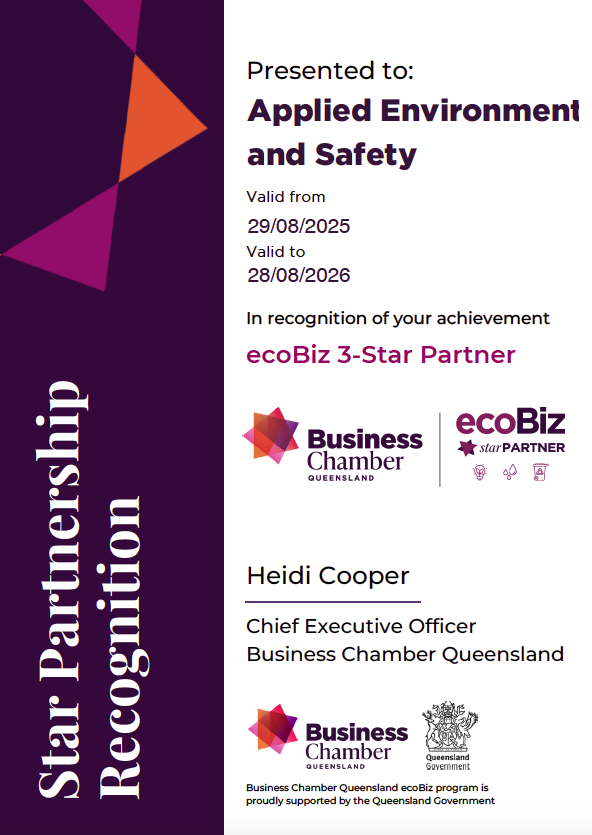
Applied Environment & Safety is proud to again be awarded 3-Star Partner with the Business Chamber of Queensland ecoBiz program. For ten years, we have been active participants in the ecoBiz program and recognised as Star Partners.
ecoBiz Star Partner program is focussed on sustainable business practices to reduce energy and water use, and minimise waste. ecoBiz is a free program, funded by the Queensland Government, that helps businesses save money through reducing energy, water and waste. ecoBiz has been a very successful program working with thousands of Queensland businesses.
Our business sustainability initiatives have been recognised through this program.
Our ecoBiz Star Partner achievements for 2024-2025 regarding energy, water and waste are:
Energy
Recertified as a Carbon Neutral business through Climate Active in May 2025
Less travel for work with new local clients and providing remote support
Calculated reduction in energy use with electricity fed back into the grid from home solar
Water
Low flow taps and dual flush toilets installed
Ongoing member of local catchment group
Ongoing volunteer for Noosa River Catchment group undertaking monthly water sampling
Waste
Recycling of eWaste, pens, batteries etc
No printing; all digital
Ongoing support for container recycling program by our company and client initiatives
You can read more about business sustainability at Applied Environment & Safety HERE.
Tracking of our carbon offsets, container recycling and donations are reported on our website HERE.
We are setting new energy, water and waste initiatives for the next financial year. We will keep you updated on the progress of these initiatives.
Iina has recently joined Applied Environment & Safety adding her strong research skills and passion for sustainability to the team. She enjoys researching environmental issues and collaborating with teams to create innovative environmental solutions.
Iina completed a Bachelor of Landscape Architecture in 2001 and has continued her studies including an Advanced Diploma of Sustainable Building Design as well as commenced a Masters of Regional Planning by Research at the University of the Sunshine Coast.
Iina has diverse interests in research related to climate change adaptation, landscapes and social adaptation. She has explored how this may relate to the reintegration of traditional ecological knowledge and urban agriculture into peri-urban regions as well as consideration of social and environmental issues associated with small lot housing estates. She is also interested in the way older Australians maintain their housing resilience and self-care.
Over the past few months, Iina has been assisting Applied Environment & Safety with a diverse set of environmental and business planning projects. She has completed environment and safety audits to aid onsite personnel to manage their requirements in a streamlined way; completed compliance reviews leading to the drafting of new policies and procedures; supported clients with the provision of information about environmental licencing and regulatory requirements; and conducted ecological assessment project work.
In her spare time, she is a keen supporter of citizen science environmental projects. She believes that this is worth developing with younger generations to inspire social change for the good for the environment.
Earlier in the month, Applied Environment & Safety was invited to present as a showcase local business at the Biz to Net Zero business breakfast in Noosa, a net zero industry and innovation program.
The event was coordinated by CCIQ ecoBiz Leader’s Forum, Noosa Shire Council, and local business associations. More than 100 local business people keen to learn about how to achieve carbon neutrality in their business or to start the journey, attended this event.
The purpose of this event was to engage the local business community in practical carbon reduction and offset solutions to support them through the economic transition to a zero-carbon future, as a proactive response to climate change. The event was aimed to provide clarity around the benefits to business of reducing emissions, investing in offsets and promoting themselves as carbon neutral in the context of net zero.
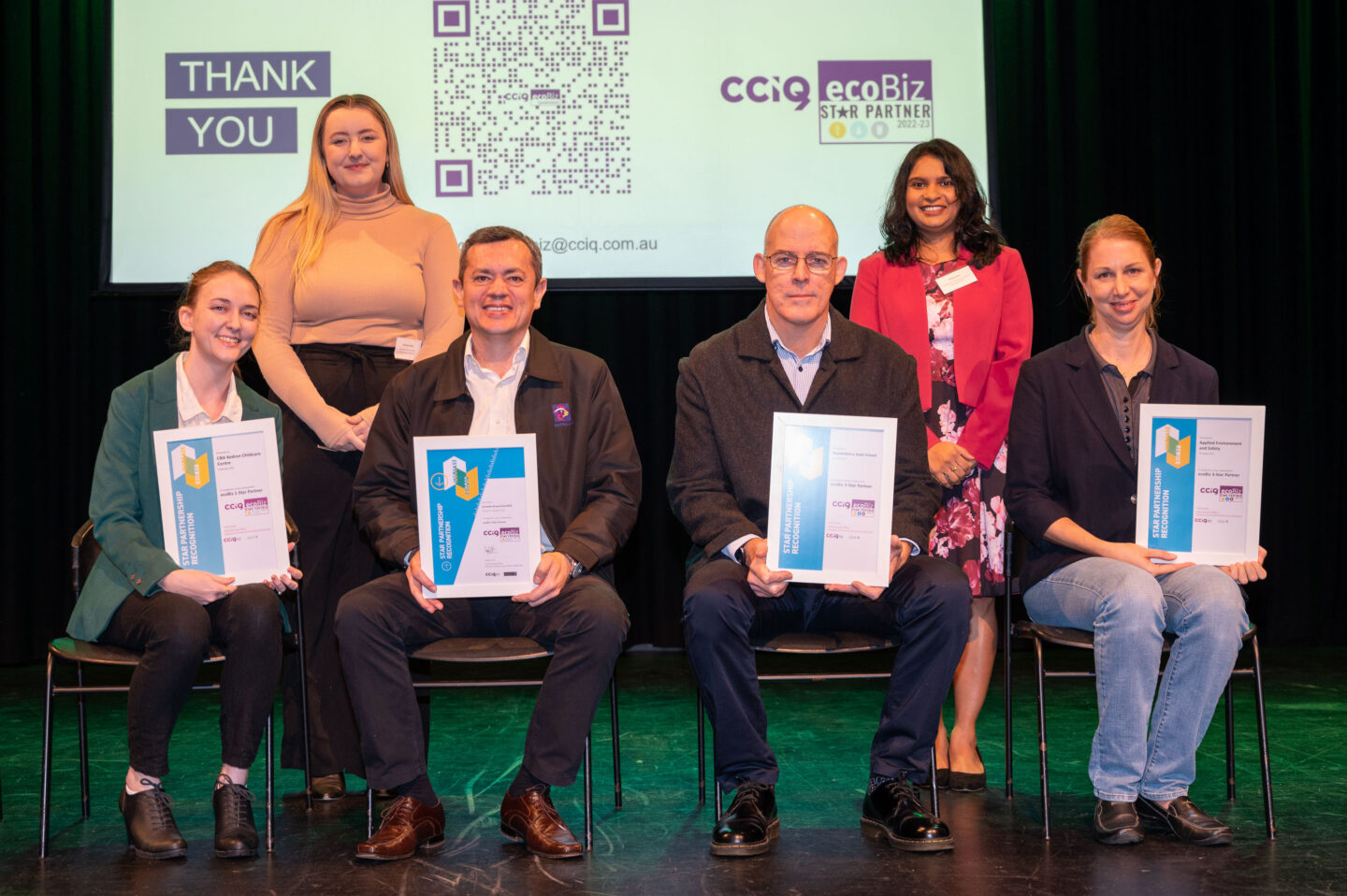
Also a focus of the event was celebrating ecoBiz Partners by recognising and awarding them with Partnership Certificates. Applied Environment & Safety was awarded 3-Star Partnership again this year. We have been active participants in the ecoBiz program and a recognised Star Partner for over five years. Through this program, we have been implementing sustainable business practices based on reducing energy and water use, and waste minimisation.
Melanie Dixon, Director of Applied Environment & Safety, was a guest speaker at the event. Melanie spoke about when starting her business over eight years ago it was important to her that the company led by example. So she reached out to ecoBiz and together we have been implementing sustainable business practices since 2015. Then in 2020, we started the process to become carbon neutral.
So What is Next?
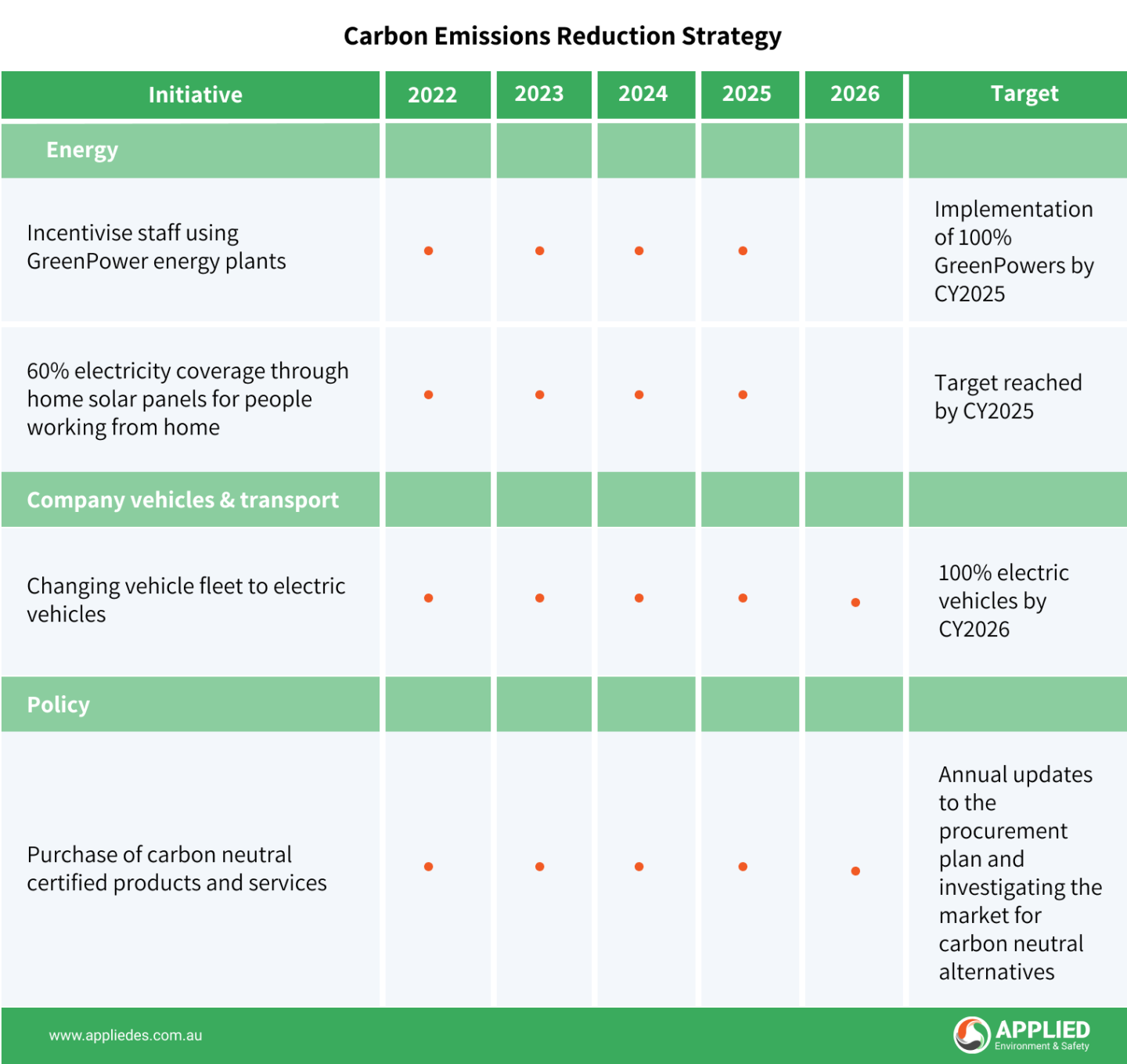
Applied Environment & Safety have just set our carbon emissions reduction strategy for the next five years which includes changing to electric vehicles and supporting other carbon neutral businesses. See below.
We are working on building our local client base as well as encouraging our clients to allow us to provide remote support. These both assist in reducing our travel and associated energy use. We are also looking for further opportunities to support our local community and environment through volunteering. Melanie has just become a WaterWatch volunteer, participating in monthly water sampling, as part of Noosa Integrated Catchment Association.
We really believe that every person and every business can make a difference. You don’t need to be a big organisation, or spend a lot of money, there are sustainable options, sustainable choices for everyone and every business.
If you need some advice about your carbon neural journey feel free to contact us with your questions and queries.
Environmental Management for Road Construction and Civil Earthworks
Road construction and civil earthworks, including demolition, bulk earthworks and maintenance works, are likely to have environmental impacts. These environmental impacts may include clearing of native vegetation; discharge of sediment or water into nearby stormwater drains or waterways; emissions of noise, dust, or odours that cause nuisance or potential health impacts; the escape of litter; or excavation or importation of unsuitable fill materials.
All of these potential impacts should be considered prior to construction and an effective plan developed to manage impacts on the environment, and other nearby sensitive receivers.
What are the Environmental Requirements?
Environmental laws and regulations relevant to your road or civil construction project will be depend on the type of works, the location and potential sensitive receivers. In Australia, federal, state and local governments jointly administer environmental protection laws.
During planning for your road construction or civil earthworks project, a legislative review should be undertaken to determine:
1. Implications of the proposed project in relation to Commonwealth, State and local laws
2. Non-statutory approvals requirements such as the Queensland Government Koala Conservation Policy as well as self-assessable guidelines and codes
3. Other obligations required for compliance with legislation such as standards
4. The potential for environmental offsets triggered by the project.
Approval for a construction or civil works project issued by the relevant authority, such as local council or state government, can have conditions relating to the minimisation of environmental harm and local nuisance. A common condition is the requirement to prepare a Construction Environmental Management Plan or CEMP.
What is a Construction Environmental Management Plan (CEMP)?
A CEMP describes how construction activities will be managed to avoid or minimise environmental impacts. As well as how environmental management requirements will be implemented. A CEMP should be prepared when there is a risk that construction activities could cause environmental harm or environmental nuisance.
What is the Purpose of a CEMP?
A CEMP describes how the construction activities will be managed to avoid or mitigate environmental or nuisance impacts, and how those environmental management requirements will be implemented.
What is the Content of a CEMP?
A CEMP needs to contain sufficient information to demonstrate that the potential impacts on the environment and surrounding community have been identified, and suitable measures to mitigate those impacts will be applied prior to and during construction.
A CEMP should include the following general information about the project:
– Description of the location and receiving environment including sensitive receivers
– Description of the construction works to be undertaken
– Identification and analysis of potential environmental impacts
– Identification and description of the management measures to be implemented to mitigate linked source−receptor−exposure pathways
– Identification of a person or persons with responsibility for implementing the control measures
The CEMP could also include information on any higher-level environmental management systems, work procedures, document control, corrective action and review procedures. For more information refer to our Environmental Management Plan article. Or, download our key components of an Environmental Management Plan here.
To prevent or minimise environmental impact, it is important to understand the link between construction activities and the potential for these activities to impact on the environment.
Construction Activities and Environmental Impacts
The types of environmental aspects that need to be considered may include:
– Flora and fauna
– Erosion and sedimentation
– Water quality including groundwater
– Air quality
– Indigenous and non-indigenous heritage
– Noise and vibration
– Waste
– Hazardous materials
– Rehabilitation
Examples of the potential environmental impacts from construction activities on these environmental aspects are summarised in the table below.
Environmental management measures to be implemented during construction will depend on the nature of the site activities, and the sensitivity of the project area and surrounding land or water environment. For example, excavations resulting in steep slopes are likely to lead to soil erosion and water quality problems downstream and will require the installation of erosion protection measures.
Why Your Civil or Road Construction Project Needs to Comply
Environmental compliance means conforming with relevant environmental laws, regulations, standards and other requirements. The importance of being compliant with your environmental requirements isn’t just about being green, it is essential to ensuring the success of your construction project by limiting your exposure to regulatory and public scrutiny; ensuring compliance with contractual and best practice requirements; as well as identifying opportunities for improvement.
An environmental audit can be used to investigate the compliance of your project and/or the extent of your environmental liability. An environmental audit evaluates the compliance of management systems and plans with regulations, internal policies or other compliance drivers. Assurance through auditing verification and reporting programs can be used to identify gaps and limitations as well as allocate ownership and accountability to the process of implementing environmental compliance for your project.
Applied Environment & Safety provided environmental support to Hazell Bros during their road construction project. This 8.1 million project involved intersection upgrades and safety widening works on the Bruce Highway located between Gympie and Maryborough in southeast Queensland.
Our role in this local project included environmental audits and inspections during construction. At the commencement of construction, an audit was undertaken to ensure compliance with the requirements in the CEMP. Then monthly inspections were undertaken to ensure ongoing compliance. This included inspection of sediment and erosion controls, waste and water management, and hazardous substance storage and use. Short reports were developed following the inspections for submission to the Department of Transport and Main Roads.
We believe in using our expertise and knowledge to add value and improve project outcomes for our clients. We used our extensive construction knowledge to identify environmental risks and provide practical solutions. Contact us.
A management system provides structured policies and processes designed to help companies manage their impacts and improve their performance. A management system defines how a company will identify, assess, monitor and maintain their interactions with their workers and the working environment.
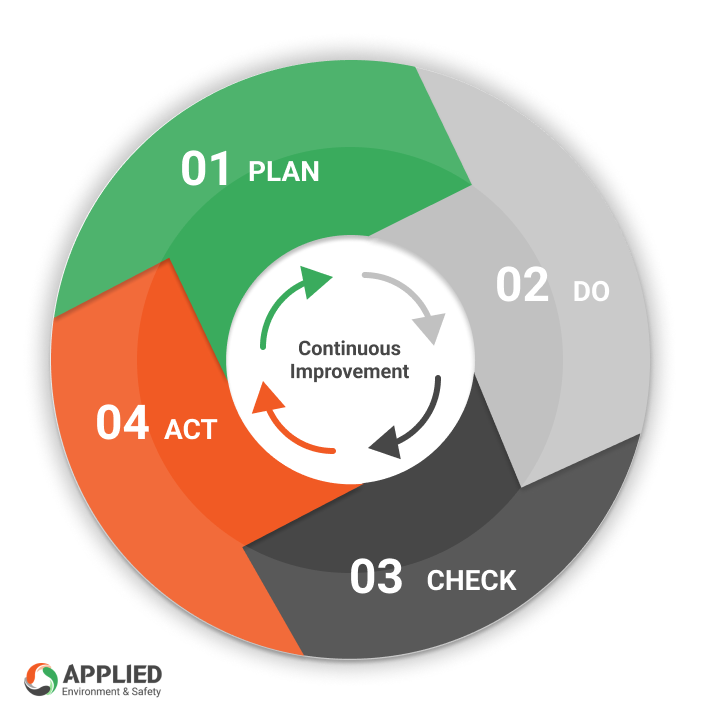
Management systems are made up of a series of interconnected elements that drive continual improvement. In order to deliver continual improvement consistently across a company, management processes are typically based on a four-phase cycle: Plan, Do, Check, Act.
1. Plan for an activity
2. Do the activity
3. Check effectiveness of controls
4 Act on implementing the process with the effective controls
Management Systems Plan Do Check Act – PDCA Diagram
For further information on the Plan, Do, Check, Act cycle see our Management Systems article.
What is a Health & Safety Management System (HSMS)?
A Health & Safety Management System (HSMS) provides a systematic approach to managing health and safety. A HSMS helps an organisation to establish, implement, and maintain policies and processes to eliminate hazards, minimise risks including system deficiencies, and address nonconformities.
The purpose of a HSMS is to set out, in a structured and organised way, the particular aspects of your operations that influence the health and safety outcomes of your workers and other people at your worksites.
HSMS Structure
The size and the complexity of your company will influence how your HSMS is developed; that is the format of the system and level of information that is included. For small companies undertaking lower risk operations to health and safety, the structure of the HSMS may be organised into one document. For large organisations with multiple sites and various operations and/or high-risk activities then various policies, standards, procedures and plans may be required to ensure an effective management system.
The HSMS will document the following:
Safety policy: this will outline the company’s intentions in relation to how health and safety outcomes will be managed
Management structure: this ensures that the people who have particular responsibilities for safety are clearly identified
Safe work procedures: these procedures describe how risks arising from particular hazards will be controlled
Processes for providing information and training and appropriate inductions for workers
Other procedural issues such as reporting of incidents, record keeping and maintenance of the safety management system
Emergency procedures
ISO 45001:2018 Occupational Health and Safety Management System
There are internationally recognised standards for management systems including ISO 45001:2018 Occupational Health and Safety. This Standard helps organisations to establish, implement, and maintain processes to eliminate hazards, minimise risks and address nonconformities. It provides guidance on how to use management processes to prevent work-related injuries and ill health, as well as how to proactively improve workplace health and safety performance.
Importance of Health and Safety Management Systems
The establishment and implementation of a HSMS is key to identifying your health and safety risks and requirements to ensure effective controls are implemented. A management system is an effective method of documenting processes and ensuring consistency in implementation as well as identifying opportunities for improvement.
The benefits of an effective HSMS include:
Improved risk management and protection of workers
Ensuring compliance with regulatory and compliance obligations
Improve employee reporting, communication, and overall safety culture
Centralisation of documentation and monitoring for continuous improvement
Developing a certified Health and Safety Management System
We can assist you with the development of a certified HSMS. Our steps for the development of a certified HSMS are:
1. Health and safety review
2. System development
3. System implementation
4. Internal audit
5. Certification audit
These steps are detailed below.
Health and Safety Review
Before we start, we will provide you with background information about the standard, AS/NZS ISO 45001:2018 , that the system is being developed in accordance with.
During the review your consultant will:
Explain the requirements of the Standard
Work with you to identify and assess of all hazards and relevant risks
Demonstrate the use of a Risk Assessment Model to assess and prioritise risks
Work with you to establish health and safety objectives and targets
System Development
Your HSMS, including all procedures and documentation required for certification will be developed by an experienced consultant. If you already have health and safety documents and processes, these will be integrated into the management system.
You will review the system and provide us with feedback. If necessary, we will change the system based on your feedback.
Implementation
Your consultant will provide you with clear guidance on how to implement the system into your business. We will help you understand the everyday requirements of your HSMS and its applicability and alignment with your health and safety objectives and targets.
We will provide assistance with any issue, query or request you may have to assist you with implementing the system in your business.
Internal Audit
Before certification, an internal audit of the system is required. The internal audit will be conducted by your Applied Environment & Safety consultant to ensure the successful implementation of the management system. A detailed audit report with recommendations will be provided.
Certification Audit
We will help you to select a certification body appropriate to your needs and liaise with them regarding the timing of the certification audit to ensure that you are prepared and that your timescales are met.
The management system will be certified for conformance with the Standard by a third-party certifying body. Your Applied Environment & Safety consultant will be available, generally by phone, during Stage 1 of the certification audit.
Do you need assistance?
We have vast experience in the review, development and implementation of health and safety management systems.
Our experience includes:
Management system compliance review
Review and development of management systems to Standards and other regulatory requirements
Management system documents development including policies, standards, and safe operating procedures development
Auditing of management system for compliance and opportunities for improvement
Contact us if you need further support or have detailed question for our team of experts.
How to Conduct an Effective Internal Audit (ISO 14001) + FREE Template
Conducting internal audits of your EMS is important to evaluate the effectiveness and implementation of the management system. Using an ISO 14001 Internal Audit Checklist can help identify improvement opportunities and ensure compliance with environmental management standards. To make the process easier, download our FREE ISO 14001 Internal Audit Checklist and follow this guide to improve your environmental performance. This article provides an overview of ISO 14001, the environmental management system framework, and the importance of conducting internal audits.
What is ISO 14001?
ISO 14001 is an internationally-recognised framework that provides organisations with the requirements of an environmental management system. An environmental management system (EMS) aligned with the ISO 14001 Standard allows an organisation to identify their environmental risks, and implement processes to ensure continual improvement.
An effectively implemented EMS allows an organisation to minimise its impact on the environment, and optimise environmental opportunities through a systematic framework. This is achieved through mapping out organisational strategic objectives and aligning them with goals and outcomes that are environmentally sustainable.
In essence, ISO 14001 provides a framework that determines how your organisation is currently impacting the environment, identifying areas of improvement and potential risks along the way.
Why is ISO 14001 Important?
There are many reasons why an organisation should take a strategic approach to improve its environmental performance.
Users of the standard have reported that ISO 14001 helps:
– Demonstrate compliance with statutory and regulatory requirements
– Achieve strategic business aims by incorporating environmental issues into business management
– Increase leadership involvement and engagement of employees
– Provide a competitive and financial advantage through improved efficiencies and reduced costs
– Improve company reputation and confidence of stakeholders through strategic communication
– Encourage improved environmental performance of suppliers by integrating them into the organisation’s business systems
Implementation of ISO 14001
Below are some key considerations for the implementation of an EMS aligned to ISO 14001.
Context of the Organisation:
Consideration of the external and internal issues that can affect the intended outcomes of the system need to be included in your EMS. The needs and expectations of interested parties should also be considered in regard to environmental management.
Emphasis on Leadership and Commitment:
It is widely recognised that a successful management system requires commitment and support from top management. Emphasis on leadership by top management is required in the Standard. This includes the integration of environmental management into the organisation’s core strategies, processes and priorities.
Risk Approach to Management:
The Standard requires the identification, determination and inclusion of aspects that can have a significant environmental impact as part of a risk based management approach. This includes the requirement for organisations to specify the criteria used to determine risk.
Life Cycle Perspective:
Thinking of each stage of a product or service as part of a lifecycle perspective is required under the Standard. This includes considering the organisation’s control or influence during procurement through to end-of-life treatments.
Audits For Compliance
An audit is a systematic, independent and documented process for determining whether your management systems and processes effectively address specific risks and are being implemented in accordance with internal and external requirements.
The objective of an ISO 14001 audit is to assess operations to identify strengths and weaknesses, determine effectiveness and compliance, and measure progress. This will be in relation to:
– Compliance with statutory and ISO standard requirements
– Staff awareness of risks and controls
– Implementation of policies, standards and procedures
– Maintaining accreditation or other external stakeholder requirements
An ISO 14001 internal audit checklist can be used as an effective tool for checking the implementation of your EMS. Self-auditing can help to define a high-level overview of your organisation’s performance, and determine the effectiveness of the management system. It can also help to identify problem areas and successfully apply principles of continuous improvement.
Self-auditing is best used as a tool to discover the potential opportunities for innovation and continuous improvement. This is not a replacement for a third party certified body audit and will not necessarily result in ISO certification. Further details on ISO certification is provided in the next section.
We have provided you with a simple and easy-to-follow ISO 14001 internal audit template to determine your compliance against ISO 14001. Fill in your details below to download the template.
Do you need assistance?
We have vast experience in the review, development and implementation of management systems and ISO 14001 auditing. Our experience includes:
– Auditing of management system compliance and opportunities for improvement
– Development of policies and standards
– Environmental or Safety Management System review and gap analysis
– Development of environmental management procedures and safe operating procedures
– Management system document development
– Implementation of management system processes
To find out more about our experience with ISO 14001 and management systems, view our Projects here or Contact us if you need support or have a detailed question for one of our team of experts.
ISO 14001 is an internationally-recognised framework that provides organisations with the requirements of an environmental management system. An environmental management system (EMS) aligned with the ISO 14001 Standard allows an organisation to identify their environmental risks, and implement processes to ensure continual improvement.
An effectively implemented EMS allows an organisation to minimise its impact on the environment, and optimise environmental opportunities through a systematic framework. This is achieved through mapping out organisational strategic objectives and aligning them with goals and outcomes that are environmentally sustainable.
In essence, ISO 14001 provides a framework that determines how your organisation is currently impacting the environment, identifying areas of improvement and potential risks along the way.
Why is ISO 14001 Important?
There are many reasons why an organisation should take a strategic approach to improve its environmental performance.
Users of the standard have reported that ISO 14001 helps:
– Demonstrate compliance with statutory and regulatory requirements
– Increase leadership involvement and engagement of employees
– Improve company reputation and confidence of stakeholders through strategic communication
– Achieve strategic business aims by incorporating environmental issues into business management
– Provide a competitive and financial advantage through improved efficiencies and reduced costs
– Encourage improved environmental performance of suppliers by integrating them into the organisation’s business systems
Implementation of ISO 14001
Below are some key considerations for the implementation of an EMS aligned to ISO 14001.
Context of the Organisation:
Consideration of the external and internal issues that can affect the intended outcomes of the system need to be included in your EMS. The needs and expectations of interested parties should also be considered in regard to environmental management.
Emphasis on Leadership and Commitment:
It is widely recognised that a successful management system requires commitment and support from top management. Emphasis on leadership by top management is required in the Standard. This includes the integration of environmental management into the organisation’s core strategies, processes and priorities.
Risk Approach to Management:
The Standard requires the identification, determination and inclusion of aspects that can have a significant environmental impact as part of a risk based management approach. This includes the requirement for organisations to specify the criteria used to determine risk.
Life Cycle Perspective:
Thinking of each stage of a product or service as part of a lifecycle perspective is required under the Standard. This includes considering the organisation’s control or influence during procurement through to end-of-life treatments.
Audits For Compliance
An audit is a systematic, independent and documented process for determining whether your management systems and processes effectively address specific risks and are being implemented in accordance with internal and external requirements.
The objective of an ISO 14001 audit is to assess operations to identify strengths and weaknesses, determine effectiveness and compliance, and measure progress. This will be in relation to:
– Compliance with statutory and ISO standard requirements
– Implementation of policies, standards and procedures
– Management control of environmental practices
– Staff awareness of risks and controls
– Maintaining accreditation or other external stakeholder requirements
An ISO internal audit checklist can be used as an effective tool for checking the implementation of your EMS. Self-auditing can help to define a high-level overview of your organisation’s performance, and determine the effectiveness of the management system. It can also help to identify problem areas and successfully apply principles of continuous improvement.
Self-auditing is best used as a tool to discover the potential opportunities for innovation and continuous improvement. This is not a replacement for a third party certified body audit and will not necessarily result in ISO certification.
Further details on ISO certification is provided in the next section.
ISO 14001 Certification
Accredited certification of your EMS to ISO 14001 is not a requirement, and organisations can enjoy many of the benefits from using the standard without going through the accredited certification process.
However, third-party certification – where an independent certification body audits your practices against the requirements of the standard – is a way of signalling to your buyers, customers, suppliers and other stakeholders that you have implemented the standard properly. What’s more, for some organisations, it helps to show how they meet regulatory or contractual requirements.
How to get Certified to ISO 14001?
If you would like more information on how to undertake an internal audit to be become certified, we would be happy to arrange a call to talk about your options, Contact Us.
In this article, we cover the topic of environmental compliance in Australia. In our industry we often refer to compliance; compliance with regulatory requirements, compliance with client or stakeholder requirements, compliance with industry best practice, and compliance with environmental management systems.
But what does environmental compliance actually mean, why should you be concerned with it and what does it entail? This article sets out to answer these questions for you.
What is Environmental Compliance?
Compliance is defined as ‘conformity in fulfilling official requirements’. That is exactly what environmental compliance means; conformity in fulfilling environmental requirements. It is the adherence to all relevant environmental laws, regulations, standards and other requirements that apply to your organisation’s activities, services and products.
The importance of being environmentally compliant isn’t just about being green. It is essential to ensure the success of your operations by limiting your exposure to penalties and public scrutiny. Furthermore, identifying opportunities for improvement.
What is the Purpose of Environmental Compliance?
One of the most straightforward arguments for environmental compliance is that you have to do it; either it is the law, your approval conditions or your contract requirements. Government agencies enforce regulations and failure to meet their regulatory requirements can lead to fines/prosecutions which can be costly.
However, there are other reasons that should encourage you to adhere to environmental compliance:
– Promoting environmental compliance and best practice can attract new customers who want to buy products and services from an environmentally friendly business.
– Reducing the environmental impact of your business will improve the sustainability of your operations for longer term success.
– Promoting your employees to take an interest in your operations and environmental compliance. Failing to do so could negatively impact on the business as a whole.
Regulatory Requirements
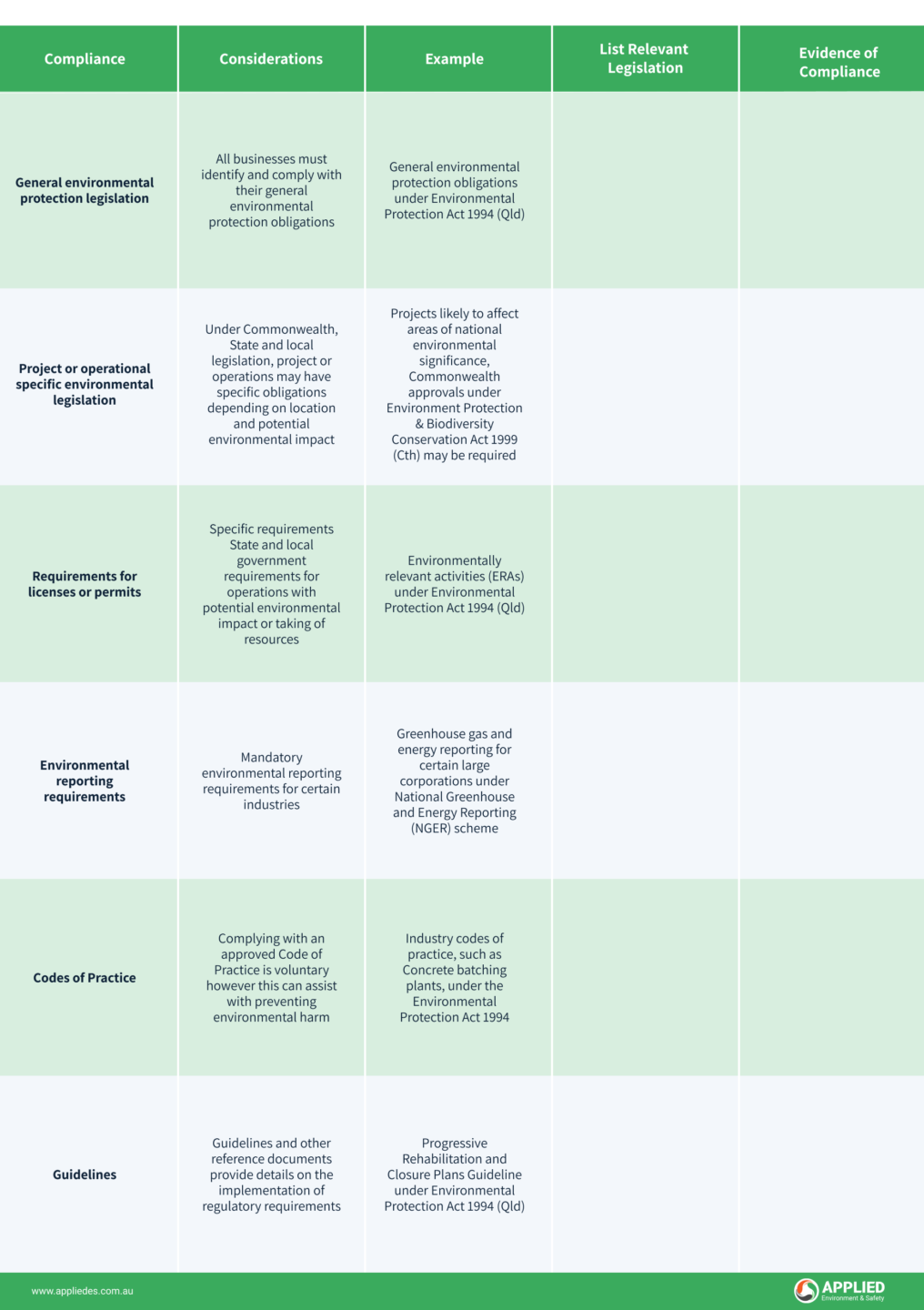
Environmental laws and regulations relevant to your organisation will depend on your operations and location. In Australia, the Commonwealth, States/Territories and Local governments jointly administer environmental protection laws.
In Queensland, you and your business have a legal duty to meet general environmental protection obligations. This applies to all businesses and citizens. The Environmental Protection Act 1994 lists obligations and offences to prevent environmental harm, nuisances and contamination.
Environmental Compliance Assessment
An assessment of your environmental compliance with relevant legislation can be complicated. We have put together an environmental compliance assessment checklist below to assist you with considering your compliance obligations.
Environmental Compliance Checklist
An environmental compliance audit can be used to assess your compliance as discussed in the section below.
We would recommend engaging Applied Environment & Safety to undertake an assessment of your compliance with relevant environmental requirements. Examples of compliance assessments that we undertaken are detailed below.
Compliance Through an Environment Audit
An environmental audit can be used to investigate the compliance status your operations and/or extent of your liability. This process is a systematic evaluation focusing on current operations and management procedures and processes. Assurance through auditing verification and reporting programs can be used to identify gaps and limitations.
An environmental audit can help to assess the nature and extent of your current impacts on the environment and compliance with regulatory requirements. This will enable you to:
– Identify how you could reduce your impact
– Prioritise environmental management activities
– Demonstrate your accountability to the government, customers and shareholders.
Environmental Compliance Australia Examples
Hereunder are some practical examples of how environmental compliance is applied to a number of different industry sectors that we service.
Power & Transmission
Applied Environment & Safety provided environmental support in the early contractor involvement (ECI) stage of the ElectraNet Eyre Peninsular transmission line upgrade project. This project involved constructing a new 270 km transmission line from Cultana to Port Lincoln in South Australia, as well as major construction works on substations.
Specific environmental management sub-plans were developed to ensure compliance with legislation, project-specific approvals and client contract specifications. This included soil, water, vegetation, waste, landholder and cultural heritage sub-plans.
Permit applications were also developed to ensure compliance with South Australian legislation. This included Water Affecting Activities Permits for the construction of waterway crossings.
Onshore Oil & Gas
Applied Environment & Safety regularly provides health, safety and environmental management support to Buru Energy. Buru Energy is an onshore oil and gas company based in Western Australia.
Recently we were engaged by Buru Energy to undertake an audit of their Health, Safety and Environmental Management System against relevant legislation. This included undertaking a review and gap analysis of their current management system documents. An audit report with recommendations to ensure compliance was developed following the audit.
Roads & Transports
Applied Environment & Safety, provided environmental compliance support to Hazell Bros during the construction of the Bruce Highway upgrade project located between Gympie and Maryborough in southeast Queensland.
At the commencement of construction, an audit was undertaken to ensure compliance with the requirements in the Environmental Management Plan. Then monthly inspections were undertaken to ensure ongoing compliance. This included inspection of sediment and erosion controls, waste and water management, and hazardous substance storage and use. Short reports were developed following the inspections for submission to the Department of Transport and Main Roads.
If you have any further questions or queries about environmental compliance or your project needs an environmental compliance audit, contact us.
Applied Environment & Safety have been nominated for the Noosa Biosphere Awards 2021. We believe in leading by example and promoting environmental sustainability. This is demonstrated through our commitment within our business as well as seeking continuous improvement for our clients.
Applied Environment & Safety are based in Noosa on the Sunshine Coast, Queensland. Noosa is recognised globally for its outstanding biodiversity values and rich cultural history.
About the Noose Biosphere Awards
The Noosa Biosphere Awards celebrates the individuals, businesses and organisations implementing local solutions to the global challenges of sustainable development and addressing climate change. The Awards recognise people who are making a difference in the community and are championing environmental and sustainability excellence.
In 2007, the Noosa Shire was awarded Biosphere Reserve status under the UNESCO Man and the Biosphere Programme in recognition of the ongoing efforts of the community to manage Noosa’s land, waters and wildlife sustainably while maintaining a balance between people and nature. The Noosa Biosphere is one of only four recognised UNESCO biosphere reserves in Australia and is part of a network of more than 700 sites worldwide.
This year the Noosa Biosphere Reserve Foundation launched the first Noosa Biosphere Awards. The Noosa Biosphere Awards aim to celebrate local projects, products and services that align with the UNESCO Programme objectives and aim to broadly address the UN Sustainable Development Goals.
Our nomination for the awards are linked to our company values and business goals which are to promote environmental sustainability both within our company and for our clients.
Our Company Values
Our company values are making a difference through profit, people and place.
Profit: Sustainable company that adds value to our clients leading to positive environmental and safety cultures
People: Provide opportunities both within our company and to our wider community
Place: Respect the environment and community of the locations of our projects and our business practices
Our Business Goals
We have set business goals to align with our company values as well as the UN Sustainable Development Goals in particular:
– Promoting inclusive and sustainable economic growth
– Responsible consumption and production
– Climate action
Our business goals are detailed below.
Build a Local Client Base
Following our carbon emissions reduction goal, we are focussing on building our local client base. Over the past five years, we have built a successful small business based on environmental consulting for large construction projects across Australia. Although this has been successful for us, we want to sustainably grow our business and provide more benefits to our local region, therefore we are focused on building on local opportunities.
Create Opportunities
Through building a local client base, we are seeking to provide opportunities for local, sustainable employment and collaborations. In particular, we are focused on employment diversity to suit different work-life circumstances, such as university students completing studies and return to work parents. We currently employ part-time and casual workers to ensure inclusive opportunities for local employment.
Lead by Example
Although we are a small company, we believe that by leading by example and promoting environmental sustainability we are not only ensuring the long-term viability of our business, we are also setting an example for sustainable economic growth for other small businesses in our region and broader.
We will continue on our journey and seek new opportunities for using environmental science to safeguard natural ecosystems through the projects we support for our clients. As well as promoting innovative approaches to economic development through our business practices to enhance the relationship between our people and our environment for our biosphere and wider.
Want to learn more about who we are and our core companies values, click here.
Noose Biosphere awards winners will be announced Tuesday, 2 November at the Noosa Biosphere Gala.
Environmental Rehabilitation Management – An Introduction
Environmental rehabilitation means restoration of disturbed areas and seeks to reverse negative environmental impacts. Environmental disturbance or damage can happen at a local, landscape or region scale by many activities including mining, agriculture, urbanisation or other development. There can be various negative effects of this disturbance including biodiversity loss, soil and water contamination, and impacts on other ecosystem systems.
The objective of environmental rehabilitation is to ensure that all environmental aspects are adequately addressed to minimise ongoing negative impacts from disturbance.
In this article we explain the following foundational topics:
A common application of environmental rehabilitation is the restoration of disturbed land following vegetation clearing and/or soil disturbance. Rehabilitation should ensure that disturbed areas are restored, leaving a stable environment that is conducive to the establishment of landscapes characteristic to the area.
Land Rehabilitation
The main aim of land disturbance rehabilitation is to provide a protective soil cover through vegetation cover. Vegetation acts to reduce dust and wind erosion, suppress weed infestations and provide protection to exposed soil surfaces from raindrop impacts and erosion processes. This then allows for further productive ecosystems on stable landforms.
Specific Rehabilitation Requirements
Some industries, particularly those with potential significant or long term environmental impacts, will have specific rehabilitation requirements including the development and approval of specific rehabilitation management plans.
In Queensland under the Mineral and Energy Resources (Financial Provisioning) Act 2018, the State Government has established the requirement for a life-of-mine plan (i.e. from commencement through to surrender) through a Progressive Rehabilitation and Closure Plan.
Describe the intended post-mining land use or non-use management area
Outline rehabilitation techniques for achieving the post-mining land use or management measures for a non-use management area
Map where mining and rehabilitation activities are forecast to occur
Set binding (enforceable), time-based milestones for actions that achieve progressive rehabilitation or management outcomes
Progressive Rehabilitation
Rehabilitation is an important part of a project’s environmental performance and is effectively considered as another component of operations. Rehabilitation should not be considered as something that begins towards the end of the project, but rather a process that begins in the planning phase and is progressively sequenced throughout the life of the operation.
Why Environmental Rehabilitation is Important?
Effective rehabilitation planning and implementation can be a ‘win/win’ for Project Managers and stakeholders. When executed well, it can:
Reduce financial risk and liabilities
Reduce costs in relation to environmental bonds / security deposits
Improve regulator and stakeholder confidence.
Early planning can also reduce future costs by ensuring operations are conducted in a way that facilitates and maximises the efficiency of rehabilitation.
Poor rehabilitation can lead to environmental, social and economic legacy issues, which may require regulatory intervention and result in financial uncertainty, reputational damage, potential liability and difficulties obtaining approvals and finance for future projects.
What is a Rehabilitation Management Plan?
A Rehabilitation Management Plan describes the rehabilitation objectives, strategies and actions that are necessary to address rehabilitation of a disturbed area. The strategies should be designed to ensure maintenance-free rehabilitation over the long term.
For small scale disturbance or restoration projects, a Rehabilitation Management Plan may be developed as a scaled drawing showing the location, site context, management detail and management specifications of treatment areas that require submission to your local Council for approval. For larger-scale projects or specific industries, such as mining as previously mentioned, a Rehabilitation Management Plan may be required to be developed in accordance with specific legislation requirements and form part of your development approval.
Although each project may have very different requirements in regards to the development of a Rehabilitation Management Plan, there is a typical process to be followed as provided in the next section. We would recommend that you speak to one of our experienced Environmental Consultants to discuss your requirements for rehabilitation management.
The process to Develop a Rehabilitation Management Plan
The typical process followed for the planning and development of a Rehabilitation Management Plan can be seen hereunder:
Rehabilitation Management Plan
Steps for Successful Rehabilitation
To successfully rehabilitate disturbed areas, it is important to plan, implement and monitor.
Here are six steps to set you up for successful rehabilitation:
Plan for rehabilitation. Prior to disturbance, plan and prepare for rehabilitation including retention of vegetation, topsoil and fauna habitat.
Understand your local environment and constraints. What season will rehabilitation take place? Will the disturbed area be impacted by the wider catchment area? Are the soils dispersive, saline, acidic or low in nutrients?
If your site is prone to erosion, choose the correct erosion control material or design protection around your site.
Select the appropriate plant species. As part of your project’s approval, you may need replant native vegetation species. Sometimes you will need to return a vegetated cover to stop erosion.
Install your erosion control, seeds and plants properly. Make sure your contractors or ground staff do not blast tubestock out of the ground with high pressure water. Ensure your erosion control is properly installed. Always ask an expert if you are unsure about the ‘right’ way to do something.
Inspect and maintain. Plants may die, some seeds might not germinate or erosion control might need maintenance. It is important to do regular inspections to fix these problems as they arise. The longer you leave these issues the more difficult they might become to remediate.
How Applied Environment & Safety Can Help
Applied Environment & Safety have supported projects through to rehabilitation. For the TransGrid Wagga Wagga to Tumut transmission line rebuild project, substantial earthworks were required to establish safe access and construction work areas. These large-scale disturbed areas were monitored and managed from construction through to rehabilitation.
Planning and early engagement with earthmoving contractors ensured valuable topsoils and vegetation were managed appropriately for reuse in rehabilitation. Other rehabilitation controls included erosion and sediment controls; topsoil stockpiling and management; and seeding to promote vegetation growth and ground stabilisation.
For more information on the Projects that we have supported, see our Projects Page.
Environmental Management Plan (EMP) – Key Requirements for Development
An Environmental Management Plan or EMP is a key tool to ensuring appropriate management practices are implemented during your project or operations. An effectively implemented EMP will ensure compliance with legislation and approval conditions as well as implementing best practice environmental management.
An EMP describes how your project or operations may impact on the environment and sets commitments on how these impacts will be avoided, minimised and managed so that they are environmentally acceptable.
This article details the key requirements of developing an EMP and will cover the following topics:
An Environment Management Plan is a site or project-specific plan developed to ensure that appropriate environmental management practices are followed during construction and/or operations. An EMP is a guidance document used to plan, implement, measure and achieve compliance with the environmental protection and mitigation requirements. These compliance requirements include relevant legislation, project-specific approvals and other stakeholder requirements.
After being developed, the EMP may be required to be submitted to a regulator, client or other interested parties for approval. When it has been approved for the works, it becomes a compliance document required to be implemented by all management, workers, contractors and subcontractors. Therefore, the EMP should be developed to ensure that all personnel can understand the potential environmental risks, and implement the controls to manage these risks.
To ensure that the EMP is effectively managing environmental risks, the Plan should specify how management measures will be monitored and reviewed. This should include the methodology, frequency and duration of monitoring and review activities. It should also include triggers under which corrective actions are taken.
What goes in an Environmental Management Plan?
The size and the complexity of a project will influence how the EMP is developed, that is the format of the plan and level of information that is included.
For small projects, such as projects small in area with no complex environmental issues, the structure of the EMP may be organised into checklists or tables. For large projects, such as multiple sites and/or complex environmental issues, multiple plans or tables may be required based on each stage; each site or operation; and/or environmental issues.
In simple terms, the main focus of an EMP is the development of a plan that is specific to the project or operations and outlines:
Environmental issues
Potential outcome of these issues
How these issues will be managed through monitoring and implementation
This section sets the requirements and processes for implementing the management plan and includes:
Environmental Management Structure and Responsibility: organisational structure responsible for environmental management for the project.
Approvals and Regulation Requirements: tables or lists of relevant legislation, conditions of approvals or consent, and any other requirements such as stakeholder agreements, environmental management system requirements, etc.
Reporting: description of reporting requirements including under legislation, construction monitoring, non-compliance and auditing.
Environmental Training: both general environmental awareness training and training about their responsibilities under the EMP.
Emergency Contacts and Response: procedures to be followed in the event of an environmental emergency.
3. Implementation
The section identifies the environmental risks of the project and how they will be managed. This typically includes the following steps:
List all of the activities to be undertaken
Identify the actual and potential environmental impacts associated with each of the activities
Risk assess each of the environmental impacts to determine significant impacts
Determine environmental management controls and monitoring to prevent or minimise environmental impacts
Further information is provided in the next section regarding the content of this Implementation section.
4. Monitor and Review
An EMP is not static. It is a working document that requires reviews and amendments during the life of the project. This section should document how the environmental management activities will be monitored and reviewed to ensure the controls are effective and applicable to the project activities.
Example of a Construction Environmental Management Plan (CEMP)
For small projects or during the construction phase of a project, the ‘Implementation’ section of the Plan may be organised using an issues-based format. The issues-based format involves organising the environmental impacts, management activities and controls information under each identified environmental issue. This could be written as tables, separate sections of the Plan or separate Sub-plans.
The typical environmental issues included in a Construction Environmental Management Plan:
Erosion and sedimentation
Water quality
Groundwater
Air quality
Flora and fauna
Rehabilitation
Indigenous heritage
Non-indigenous heritage
Noise and vibration
Waste
Hazardous materials
Traffic.
For large projects carried out over extended periods, the ‘Implementation’ section of the EMP may be developed using a stage-based format. This involves documenting the environmental issues and control measures for each stage of a project. For example, the planning and design stage, the construction stage and the operational stage. Typically these stages would be developed as separate plans.
An Environment Management Plan (EMP) identifies the actual and potential environmental risks that may be caused by the project or operation and identifies controls to manage these risks before they result in environmental harm.
An EMP is a valuable tool to:
Define who, what, where and when environmental management and mitigation measures are to be implemented
Provide stakeholders, including government agencies, contractors and other interested parties, with better insight and control over the environmental aspects
Demonstrate due diligence
Overall, an EMP that has been specifically developed for your project or operations is key to ensuring your environmental risks are identified and appropriate management practices implemented. A well developed and effectively implemented EMP will ensure compliance with your regulatory requirements as well as implementing best practice environmental management.
If you are looking for an EMP for your project, contact us to have one of our specialists support your request.
Applied Environment & Safety are proud to be awarded 3-Star Partnership with the CCIQ ecoBiz program again this year. We have been active participants in the ecoBiz program and a recognised Star Partner for over five years. Through this program, we have been implementing sustainable business practices based on reducing energy and water use, and waste minimisation.
CCIQ ecoBiz is a free program, funded by the Queensland Government, that helps businesses save money by reducing energy, water and waste. ecoBiz has been a very successful program working with thousands of Queensland businesses.
Given that our business operates predominantly either from our home office or client locations, our ecoBiz assessment was completed on a qualitative assessment of energy, water and waste savings.
Our achievements for 2020-21 in regards to energy, water and waste are:
Energy
Solar panels installed on home office in December 2020
Commenced Carbon Neutral certification process through Climate Active in September 2020
Offset 35 tonnes of carbon, more than double our 2020 carbon emissions in June 2021
Certified as Carbon Neutral in July 2021
Water
Ongoing member of local catchment group
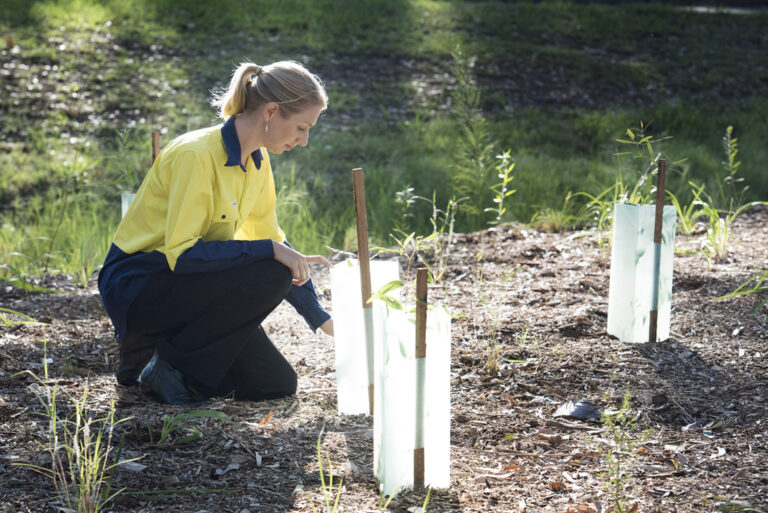
Implemented rehabilitation of council verge bushland at home office including removal of weeds, replanting native plants and mulching as waterwise garden
Waste
Ongoing implementation of the Containers for Change Refund Scheme, through our business and our clients with more than 4,000 cans/bottles have been donated so far
Keep Cups and other reusable containers utilised by employees whilst travelling
Implemented office clean-up including recycling or donation of disused electronic equipment
As a result of Applied Environment & Safety energy initiatives, we have been awarded a 3-Star ecoBiz partnership for energy, water and waste. Our assessment was based on our business practices and behaviours which demonstrate implementation of business sustainability, and minimisation of our environmental footprint.
Our sustainable business initiatives for 2021-2022 are:
Energy
Continue our Carbon Neutral certification
Focus business development on Queensland work to reduce travel and carbon emissions. Aim to increase local work by 10%
Water
Set-up water wise vegetable and herb garden at home office including use of drip irrigation and mulching
Participate in catchment group activities such as clean-up day
Waste
Ongoing implementation of Containers for Change Refund Scheme
Identify options for reducing paper waste such as use of tablets or phone apps rather than paper documents
Implement further office waste separation and disposal such as batteries and printer cartridges
We will keep you updated on the progress of these initiatives. Tracking of our carbon offsets, container recycling and donations are reported on our website News feed.