Claire Taylor has recently joined Applied Environment & Safety, adding her practical and effective environmental management to the team.
Claire completed a Master of Science, Freshwater Ecology in 2010 and since then has gained broad field-based experience, both in aquatic and terrestrial environments.
Claire has previously worked in both the public and private sector in many aspects of environmental management, including stakeholder engagement, risk assessment, data management, report writing, public communications, policy development and project management of environmental incidents.
She has recently completed a role as the Environmental Advisor for a large-scale transmission line construction project in South Australia. As the client representative, she was responsible for ongoing compliance, reporting and management of all environmental and cultural heritage aspects of the project.
In her spare time, Claire enjoys heading out for a hike and discovering all the sites that Queensland has to offer after recently moving to the Sunshine Coast. She enjoys travelling, camping, experimenting with new foods and sampling local cuisine. Her weaknesses are chilli sauce and local gin.
Claire will be providing Applied Environment & Safety’s clients with onsite environmental management and compliance support for our upcoming power, transmission and transport projects.
Allison has recently joined Applied Environment & Safety, adding her passion for environmental sustainability to the team. Allison enjoys using her extensive practical experience to collaborate with project teams to develop innovative environment and sustainability solutions.
Allison completed a Bachelor of Environmental Science in 2007 and has 15 years’ of experience working in environment and sustainability roles. She has worked throughout Australia in transport, power, renewables, water and mining sectors across project planning, design, construction, operations and maintenance.
Allison has diverse interests in compliance management and reporting, construction environmental management, infrastructure sustainability, environmental planning and approvals, and stakeholder management. Allison strives on combining sound technical advice with extensive environmental knowledge and understanding of legislation and policy to support project delivery that minimises impacts and provides benefits to the surrounding communities and environment.
Allison will be providing Applied Environment & Safety with senior environmental planning, compliance and management support for our upcoming power, transport and mining projects.
In her spare time, Allison strives to live sustainably by sourcing local produce, minimising food waste and keeping herbs and veggies in her garden alive. She will also take any opportunity she gets to tell anyone about her dog, a 10 yr old cattle dog cross called BB, who loves snoozing, barking at the postie and slow daily walks.
This article introduces the requirements of an Ecological Assessment in Queensland, which forms part of the development application process. We provide details on how we assist our clients through this process.
What is an Ecological Assessment?
The ecological assessment for developments in Queensland will vary according to the development approval pathway.
A small development, such as a residential development, is typically subject to the requirements of the local government planning scheme. The local Council will liaise with state government agencies as part of the assessment where State matters are triggered. Most local governments provide guidelines for ecological assessments to accompany development applications.
More complex developments may require submission to your local Council or maybe ‘called in’ by the State Assessment and Referral Agency (SARA) for assessment. Infrastructure projects, such as road, rail and energy infrastructure, are often subject to separate approvals processes and/or are exempt from some components of standard planning approvals processes.
For developments where matters of National Environmental Significance (MNES) are present, depending on the scale of impact, it may be necessary to refer the development to the Commonwealth government. MNES include threatened species; threatened ecological communities; lands, waters or species subject to international agreements or treaties, including migratory shorebirds; World Heritage Areas and Ramsar wetlands.
Why is ecological assessment critical?
An Ecological Assessment is part of the regulatory requirements for development applications in Queensland. An Ecological Assessment provides a means of identifying protected species or areas and determining the potential impacts of the development on these sensitivities.
How do you conduct an ecological assessment?
Qualified and experienced environmental professionals undertake Ecological Assessments. They are developed to include the relevant ecological information necessary for the development application. This will typically consist of the following:
– Description of the development
– Results of the ecological desktop assessments and field-based surveys
– An assessment of the impacts from the development on ecological values
– Recommendations to avoid or mitigate impacts of the development on ecological values
– Any further actions required
For a development application with minor disturbance, we assist our clients through the Ecological Assessment process through these steps:
– Undertake an onsite inspection of the proposed development and discussions about the works including clearing and other ground disturbance methodologies
– Inspection of disturbance area including vegetation to be cleared
– Development of Ecological Assessment Report with details from supporting reports such as arborist reports or flora and fauna surveys
– Development of management measures and offsets to minimise and mitigate the impacts from the proposed development
– Submission to local Council
– Follow up with the Council on the lodgement of the Ecological Assessment Report and respond to any questions including updating the Plan as required
As part of the Ecological Assessment, planning and design considerations are firstly considered to minimise potential environmental impacts. This may include minimising the disturbance area, avoiding areas with high biodiversity values, using existing cleared areas, and locating new infrastructure near existing infrastructure. Management measures are developed to minimise impacts including managing the vegetation clearing process.
How can Applied Environment & Safety Help?
Applied Environment & Safety has been assisting local clients with ecological assessments for their proposed developments against the Noosa Plan 2020: Biodiversity, Waterways and Wetlands Overlay Code. We have diverse experience in development applications and environmental impact assessment. This allows us to identify potential impacts and develop practical mitigation and management measures.
Google Review from our local client
– Jeff Sly –
“I highly recommend, Applied Environment & Safety, the service I received, was above and beyond, what I expected when I requested their expertise in this field. Melanie, and her team, provided a comprehensive Environmental report for the approval process to progress; we had numerous issues satisfying council requirements. Melanie worked through the issues meticulously, until approval was granted. Tanya and Jeff.”
Lachlan has recently joined Applied Environment & Safety, adding his passion for environmental sustainability to the team. He enjoys researching environmental issues and collaborating with teams to develop innovative environmental solutions.
A lifelong fascination with the natural world inspired Lachlan to pursue a career in environment management. Lachlan completed a Bachelor of Science (Wildlife and Conservation Biology) with a Distinction in 2018 and has commenced a Master of Environment at the University of Melbourne.
Lachlan has diverse interests in research related to climate change adaptation, sustainable land management, conservation and regeneration. Through taking courses at Universities in Australia, Austria and Denmark, he was able to explore a broad spectrum of academic research in environmental sciences, which has provided him with an interdisciplinary and global understanding of these fields. Experiencing alternative systems to environmental management spurred his interest in the field, driving him to undertake further coursework and a career in environmental management.
Over the past 5 years he has consolidated his practical knowledge through various field roles in environmental management, monitoring and regeneration. Working in the civil construction industry and NFP sector has allowed him to work closely with various stakeholders from the State and Federal Government to community groups. Taking an active role in small teams, he facilitated projects from inception and design to implementation.
Lachlan has been assisting Applied Environment & Safety with environmental planning for the decommissioning of the Eyre Peninsula Transmission Line project, which commences early in the new year.
In his spare time, Lachlan is a keen supporter of community environmental projects, notably waterways regeneration. Lachlan is also a keen trail runner and spends his weekends creating ceramics, his food garden and woodworking.
Key Components of a Site Environmental Management Plan (SEMP)
A Site Environmental Management Plan (SEMP) is a site-specific document identifying the environmental aspects of an activity; the potential impacts of the activity on these environmental aspect; and ways in which these impacts can be reduced through management strategies and site practices.
In simple terms, the main focus of a SEMP is the development of a plan that is specific to an activity and outlines:
– The activity to be undertaken
– Relevant environmental aspects
– Potential impacts of the activity on these aspects
– How these impacts will be managed through implementation and monitoring
Description of Activity
The SEMP should describe the activity to be undertaken. This should define the nature and scope of the activity and include the location, phases of work and timing/scheduling. The level of detail of the activity description should be sufficient to provide an understanding of each process and allow determination of the environmental potential impacts.
The SEMP should include a description of any relevant approval conditions and internal or client management requirements. The plan should distinguish between construction and operational activities, if relevant.
A site plan or drawing should also be included with the following:
– Location of work areas and access
– Environmental aspects such as waterways, native vegetation, residential housing etc
– Locations of environmental protection measures
Environmental Aspects
The SEMP should identify the environmental aspects located within or surrounding the activity area. The types of environmental aspects that need to be considered may include the following:
– Erosion and sedimentation
– Water management including stormwater
– Dust and air quality management
– Noise and vibration
– Waste minimisation and management
– Hazardous materials storage and use
– Flora and fauna including weeds
– Indigenous and non-indigenous heritage
– Rehabilitation
Potential Impacts on Environmental Aspects
It is important to understand the link between the activities and environmental aspects. An assessment should be undertaken to identify potential environmental impacts of the activity including the nature and extent of the impacts; short-term and long-term effects; and any uncertainties regarding the predicted impacts. This assessment requires two steps as detailed below.
Step 1: Identify the environmental aspects
The types of environmental aspects are listed above. There may be generic risks that relate to all of your activities, such as waste and chemical management, and then also site-specific aspects, such as surrounding vegetation, erosion and sediment and nearby houses.
Step 2: Undertake a risk assessment
Based on the environmental aspects, document the likelihood and consequence of impacts from the activity:
Likelihood
What is the likelihood that the aspect will impact the environment?
Certain = Will occur at a frequency greater than every week if preventative measures are not applied.
Likely = Will occur more than once or twice but less than weekly if preventative measures are not applied.
Unlikely = This might occur once or twice during the project if preventative measures are not applied.
Rare = Unlikely to occur during a project even if controls are missing.
Potential Impact
How severe will the potential impact be?
Catastrophic = Significant damage or impact on the environment or community
Major = Major adverse environmental or social impacts
Moderate = Moderate undesirable environmental or social impacts
Minor = No or minimal adverse environmental or social impacts
The level of risk to an environmental aspect will determine the type and amount of mitigation and management measures that will be required. Where a significant risk to the environment has been identified, environmental protection measures must be introduced to reduce the risk to an acceptable level. Aspects with a medium or low risk should also have practicable management measures implemented if these can further reduce risk. The types of management measures are detailed in the next Section.
Managing Environmental Impacts
The types of measures that may be implemented for controlling potential impacts on environmental aspects may include:
– Water diversion structures
– Soil stabilisation measures
– Sediment retention structures
– Vehicle, machinery and equipment cleaning mechanisms
– Waste separation and containment
– Bunding and other spill prevention
– Flora and fauna protection mechanisms
– Archaeological/heritage protection mechanisms
Monitoring the Effectiveness of Environmental Controls
The SEMP should specify how the effectiveness of environmental controls will be monitored. It should include the methodology, frequency and duration of monitoring activities. It should include trigger values or conditions under which corrective actions will be taken. The plan should also specify if, and when, follow-up action is required and how monitoring records will be maintained.
An example of environmental monitoring is the implementation of a Weekly Environmental Inspection to check environmental controls throughout the activity. The trigger point would be non-compliance with any of the requirements in the Weekly Environmental Inspection Checklist. This would then require an assessment of the effectiveness of the controls and the potential implementation of additional or revised controls.
Further Information on Environmental Management Plans
Applied Environment & Safety has vast experience in the development and implementation of Site Environmental Management Plans. We supported our client in the development and implementation of site-specific management plans.
PCA Ground Engineering was engaged by the local Council to undertake a road embankment stabilisation project at Sunrise Beach, Noosa, Queensland. The works were vital to maintaining the long-term serviceability of the road and drainage infrastructure at this location.
We developed the Environmental Management Plan; Sediment and Erosion Control Plan; and Rehabilitation Plan. The environmental aspects of the project included:
– Erosion and sediment control
– Biosecurity management
– Waste management
– Rehabilitation
We believe in using our expertise and knowledge improve project outcomes for our clients. We use our extensive construction knowledge to identify environmental risks and provide practical solutions.
Environmental plans and controls were effectively implemented during this project. We believe in working closely with our clients to build supportive relationships. By working together, we ensured environmental risks were mitigated during this project.
Building on our introduction to management systems, we have provided you with a simple and easy-to-follow Environmental Management System Checklist to determine your compliance against ISO 14001. We have also included a direct downloadable PDF version of the checklist to simplify your assessment process.
Context
THE ORGANISATION
Have we determined internal and external issues that will impact on our environmental management system?
INTERESTED PARTIES
Have we determined what internal and external interested parties are relevant to the environmental management system and what are their requirements?
SCOPE
Have we determined the boundaries of the environmental management system and documented the scope?
Leadership
LEADERSHIP AND COMMITMENT
Can we demonstrate top management is providing leadership and commitment to the environmental management system?
ENVIRONMENTAL POLICY
Do we have a documented environmental policy that is communicated and available?
ROLES AND RESPONSIBILITIES
Are roles and responsibilities for environmental management documented?
Planning
RISKS AND OPPORTUNITIES
Have we determined the environmental risks and opportunities related to our organisation?
Do we have plans to address them? Have we maintained records?
ENVIRONMENTAL ASPECTS
Have we determined our environmental aspects and impacts, including any significant aspects and our criteria for determining this?
Do we have plans to address them? Have we maintained records?
COMPLIANCE OBLIGATIONS
Have we determined our compliance obligations and how they apply to us? Do we have plans to address them?
Have we maintained records?
ENVIRONMENTAL OBJECTIVES
Have we established environmental objectives?
Do we monitor, measure and communicate them?
Do we have plans to address them?
Have we maintained records?
Support
RESOURCES
Have we determined and ensured the necessary resources for the environmental management system?
COMPETENCE
Do we ensure the training and competence of personnel?
Do we maintain records?
AWARENESS
Have we ensured that personnel are aware of our policy, significant aspects and processes relevant to them?
COMMUNICATION
Have we determined processes for internal and external communication relevant to environmental management including staff, contractors, visitors, regulators and interested parties?
Have we maintained records?
CONTROL OF DOCUMENTS
Do we ensure documents and records are controlled?
Operations
OPERATIONAL PLANNING AND CONTROL
Have we established and maintained procedures to meet the requirements of the environmental management system?
Do we maintain control and influence over outsourced processes?
Consistent with a life cycle perspective do we consider environmental requirements in design processes and ensure impacts associated with transportation, use and end-of life treatment are controlled?
Do we maintain records?
EMERGENCY
Have we documented processes for emergency?
Are they tested and do we evaluate effectiveness? Do we maintain records?
Improvement
NONCONFORMITY AND CORRECTIVE ACTION
Do we have processes for reporting, investigating and taking action to manage incidents and corrective action?
Do we maintain records?
CONTINUAL IMPROVEMENT
Do we continually improve the environmental management system?
Applied Environment & Safety has been assisting local clients with ecological assessments for their proposed developments against the Noosa Plan 2020: Biodiversity, Waterways and Wetlands Overlay Code.
What is included in an ecological assessment?
In summary, assessment of the proposed development against Biodiversity Significance requirements under the Noosa Plan including:
– Biodiversity values which also includes Matters of State Environmental Significance (MSES) and Wildlife Habitat (endangered or vulnerable)
– Koala Habitat assessment against Koala Priority Areas and Core Koala Habitat Area.
As well as wetlands and waterways assessment in relation to riparian areas.
We assist our clients through the ecological assessment process in 6 steps:
1. Undertake an onsite inspection of the proposed development and discussions about the works including clearing methodology.
2. Inspection of disturbance area including vegetation to be cleared.
3. Development of Ecological Assessment Report with details from supporting reports such as Arborist Report.
4. Development of management measures and offsets to minimise and mitigate the impacts from the proposed development.
5. Submission to Noosa Council.
6. Follow up with Council on the lodgement of the Ecological Assessment Report and provide responses to any questions including updating the Plan as required.
For this type of development application, planning and design considerations are first developed to minimise potential environmental impacts. This may include minimising the disturbance area, avoiding areas with high biodiversity values, use of existing cleared areas, and locating new infrastructure near existing infrastructure.
Then management measures are implemented to minimise impacts during vegetation clearing. This may include clearly delineating vegetation to be removed and those not to be impacted onsite; pre-clearing inspections; and engaging a qualified arborist to carry out clearing works.
Applied Environment & Safety has diverse experience in construction works and environmental impact assessment. This allows us to identify potential impacts and develop practical mitigation and management measures.
Local Client Testimonial
Jeff Sly
“I highly recommend, Applied Environment & Safety, The service I received, was above and beyond, what I expected when I requested their expertise in this field. Melanie, and her team, provided a comprehensive Environmental report for the approval process to progress, we had numerous issues to satisfy council requirements. Melanie worked through the issues meticulously, until approval was granted.“
Does your project need an ecological assessment? Contact our team – we would be happy to help!
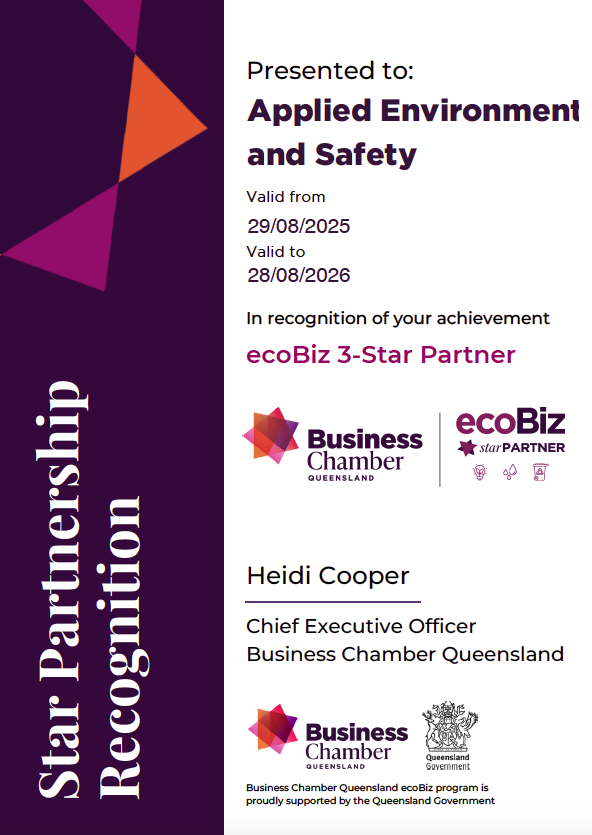
Applied Environment & Safety are proud to be awarded 3-Star Partnership with the CCIQ ecoBiz program again this year. For eight years, we have been active participants in the ecoBiz program and a recognised Star Partner. The ecoBiz program is focussed on sustainable business practices to reduce energy and water use, and minimise waste. Our business sustainability initiatives have been recognised through this program.
CCIQ ecoBiz is a free program, funded by the Queensland Government, that helps businesses save money through reducing energy, water and waste. ecoBiz has been a very successful program working with thousands of Queensland businesses.
Given that our business operates predominantly either from our home office or client locations, our ecoBiz assessment was completed on a qualitative assessment of energy, water and waste savings.
Our achievements for 2021-2022 in regards to energy, water and waste are:
Energy
Recertified as a Carbon Neutral business via Climate Active in July 2022
Less travel for work with new local clients and providing remote support
Set five year energy reduction targets – see below
Water
Ongoing member of their local catchment group
Became volunteer for Noosa River Catchment group undertaking monthly water sampling
Waste
Approx. 30,000 cans and bottles recycled through container recycling program by our company and client initiatives
Ongoing use of reusable containers while travelling
We have been awarded 3-Star ecoBiz partnership through our energy, water and waste initiatives. Our assessment was based on our business practices and behaviours which demonstrate implementation of business sustainability, and minimisation of our environmental footprint.
Our sustainable business initiatives for 2021-2022 are:
Energy
Track additional travel related energy use such as hire cars and use of clients cars to offset in next Carbon Neutral assessment
Join and participate in Zero Emissions Noosa
Determine options for supporting other carbon neutral businesses
Water
Ongoing member of local catchment group and volunteer for monthly water sampling
Up to $1,000 donation to support a water or catchment community group
Waste
Additional measures to reduce waste while travelling for work such as less takeaway
Research waste minimisation and management initiatives outside of Australia and promote through News Posts on website
We will keep you updated on the progress of these initiatives.
Tracking of our carbon offsets, container recycling and donations are reported on our website HERE.
Applied Environment & Safety is proud to again be awarded 3-Star Partnership with the Business Chamber Queensland ecoBiz program. For almost ten years, we have been active participants in the ecoBiz program and recognised as Star Partners.
The ecoBiz Star Partner program is focussed on sustainable business practices to reduce energy and water use, and minimise waste. ecoBiz is a free program, funded by the Queensland Government, that helps businesses save money through reducing energy, water and waste. ecoBiz has been a very successful program working with thousands of Queensland businesses.
Our business sustainability initiatives have been recognised through this program.
Our ecoBiz Star Partner achievements for 2023-2024 regarding energy, water and waste are:
Energy
Recertified as a Carbon Neutral business through Climate Active in May 2024
Less travel for work with new local clients and providing remote support
Calculated 20% reduction in energy use with 6,294.08 kWhs of electricity fed back into the grid from home solar
Water
Ongoing member of local catchment group
Ongoing volunteer for Noosa River Catchment group undertaking monthly water sampling
Waste
Ongoing support for container recycling program by our company and client initiatives
Ongoing use of reusable containers while travelling
Additional measures to reduce waste while travelling for work, such as less takeaways
You can read more about business sustainability at Applied Environment & Safety HERE.
Tracking of our carbon offsets, container recycling and donations are reported on our website HERE.
We are setting new energy, water and waste initiatives for the next financial year. We will keep you updated on the progress of these initiatives.
Applied Environment & Safety is proud to again be awarded 3-Star Partner with the Business Chamber of Queensland ecoBiz program. For ten years, we have been active participants in the ecoBiz program and recognised as Star Partners.
ecoBiz Star Partner program is focussed on sustainable business practices to reduce energy and water use, and minimise waste. ecoBiz is a free program, funded by the Queensland Government, that helps businesses save money through reducing energy, water and waste. ecoBiz has been a very successful program working with thousands of Queensland businesses.
Our business sustainability initiatives have been recognised through this program.
Our ecoBiz Star Partner achievements for 2024-2025 regarding energy, water and waste are:
Energy
Recertified as a Carbon Neutral business through Climate Active in May 2025
Less travel for work with new local clients and providing remote support
Calculated reduction in energy use with electricity fed back into the grid from home solar
Water
Low flow taps and dual flush toilets installed
Ongoing member of local catchment group
Ongoing volunteer for Noosa River Catchment group undertaking monthly water sampling
Waste
Recycling of eWaste, pens, batteries etc
No printing; all digital
Ongoing support for container recycling program by our company and client initiatives
You can read more about business sustainability at Applied Environment & Safety HERE.
Tracking of our carbon offsets, container recycling and donations are reported on our website HERE.
We are setting new energy, water and waste initiatives for the next financial year. We will keep you updated on the progress of these initiatives.
Iina has recently joined Applied Environment & Safety adding her strong research skills and passion for sustainability to the team. She enjoys researching environmental issues and collaborating with teams to create innovative environmental solutions.
Iina completed a Bachelor of Landscape Architecture in 2001 and has continued her studies including an Advanced Diploma of Sustainable Building Design as well as commenced a Masters of Regional Planning by Research at the University of the Sunshine Coast.
Iina has diverse interests in research related to climate change adaptation, landscapes and social adaptation. She has explored how this may relate to the reintegration of traditional ecological knowledge and urban agriculture into peri-urban regions as well as consideration of social and environmental issues associated with small lot housing estates. She is also interested in the way older Australians maintain their housing resilience and self-care.
Over the past few months, Iina has been assisting Applied Environment & Safety with a diverse set of environmental and business planning projects. She has completed environment and safety audits to aid onsite personnel to manage their requirements in a streamlined way; completed compliance reviews leading to the drafting of new policies and procedures; supported clients with the provision of information about environmental licencing and regulatory requirements; and conducted ecological assessment project work.
In her spare time, she is a keen supporter of citizen science environmental projects. She believes that this is worth developing with younger generations to inspire social change for the good for the environment.
Earlier in the month, Applied Environment & Safety was invited to present as a showcase local business at the Biz to Net Zero business breakfast in Noosa, a net zero industry and innovation program.
The event was coordinated by CCIQ ecoBiz Leader’s Forum, Noosa Shire Council, and local business associations. More than 100 local business people keen to learn about how to achieve carbon neutrality in their business or to start the journey, attended this event.
The purpose of this event was to engage the local business community in practical carbon reduction and offset solutions to support them through the economic transition to a zero-carbon future, as a proactive response to climate change. The event was aimed to provide clarity around the benefits to business of reducing emissions, investing in offsets and promoting themselves as carbon neutral in the context of net zero.
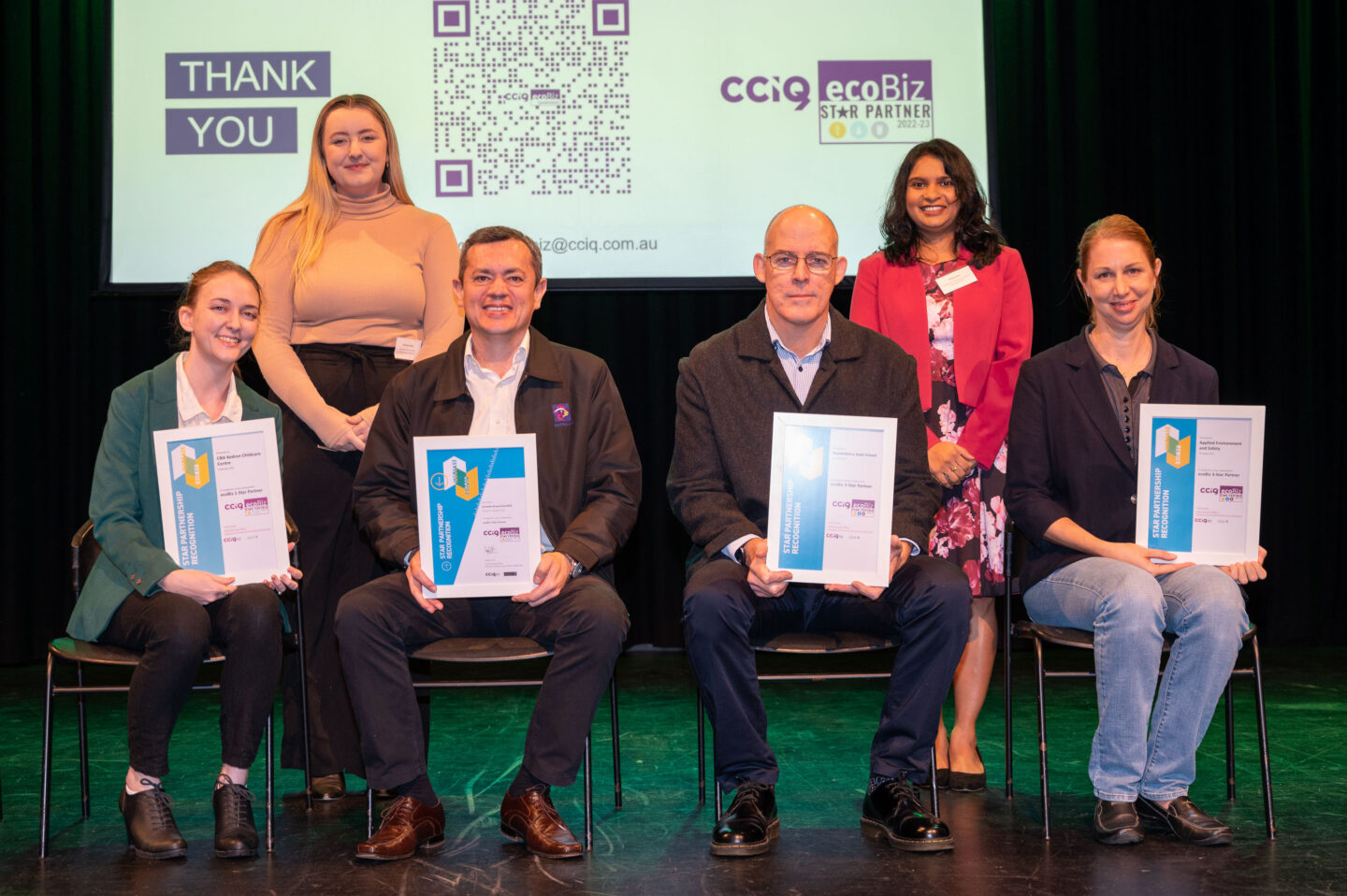
Also a focus of the event was celebrating ecoBiz Partners by recognising and awarding them with Partnership Certificates. Applied Environment & Safety was awarded 3-Star Partnership again this year. We have been active participants in the ecoBiz program and a recognised Star Partner for over five years. Through this program, we have been implementing sustainable business practices based on reducing energy and water use, and waste minimisation.
Melanie Dixon, Director of Applied Environment & Safety, was a guest speaker at the event. Melanie spoke about when starting her business over eight years ago it was important to her that the company led by example. So she reached out to ecoBiz and together we have been implementing sustainable business practices since 2015. Then in 2020, we started the process to become carbon neutral.
So What is Next?
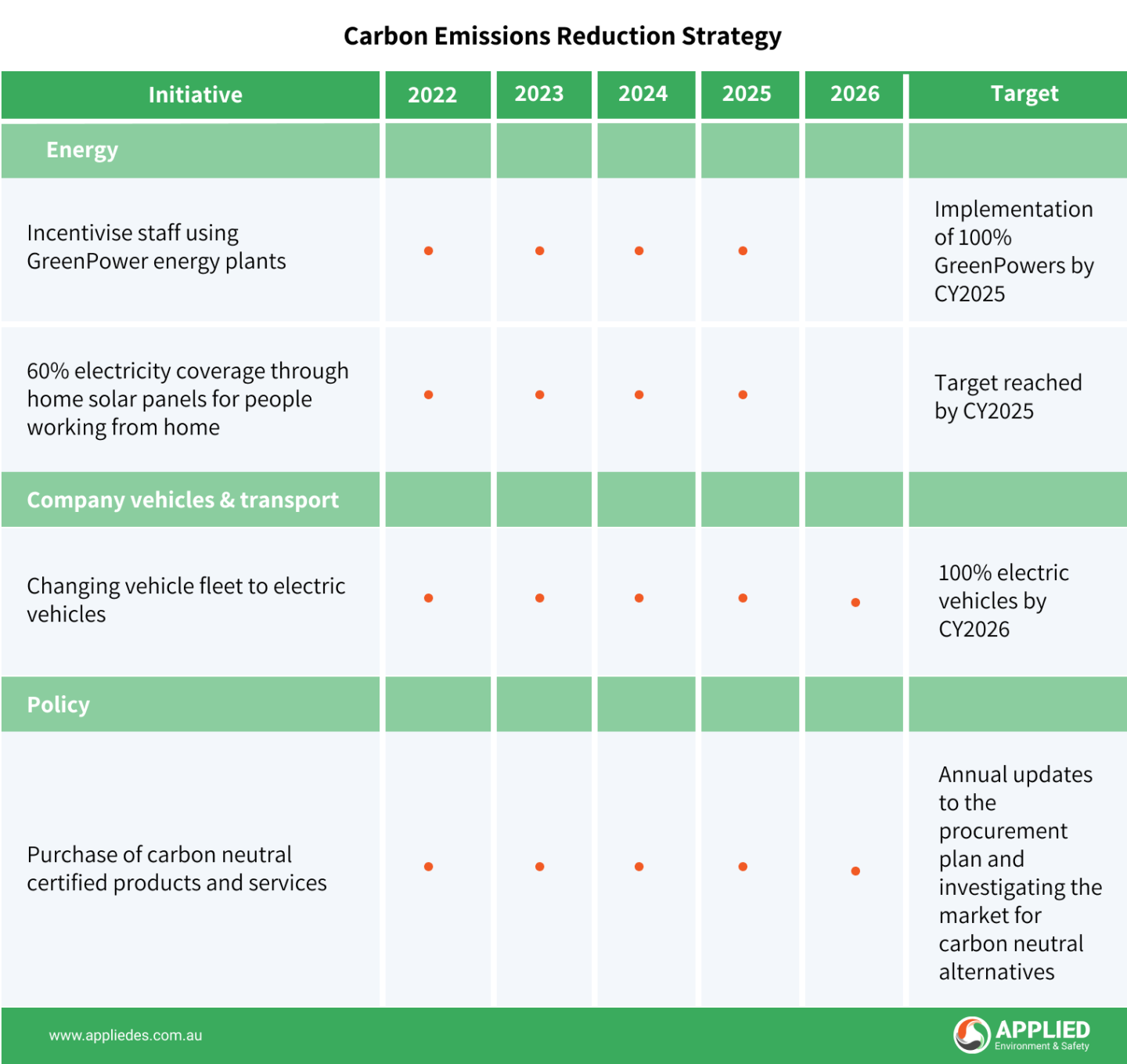
Applied Environment & Safety have just set our carbon emissions reduction strategy for the next five years which includes changing to electric vehicles and supporting other carbon neutral businesses. See below.
We are working on building our local client base as well as encouraging our clients to allow us to provide remote support. These both assist in reducing our travel and associated energy use. We are also looking for further opportunities to support our local community and environment through volunteering. Melanie has just become a WaterWatch volunteer, participating in monthly water sampling, as part of Noosa Integrated Catchment Association.
We really believe that every person and every business can make a difference. You don’t need to be a big organisation, or spend a lot of money, there are sustainable options, sustainable choices for everyone and every business.
If you need some advice about your carbon neural journey feel free to contact us with your questions and queries.